Introduction
Why does Google dominate search engine markets so completely that its nearest rival holds less than 5% of global traffic? It is one of the most important questions in digital business — and the answer is far more complex, and more revealing, than most people assume.
Why is Google the king of search engines? According to StatCounter’s data, Google had an astonishing 90.04% of the search engine market share worldwide in January 2026. The company processes over 5.9 trillion searches annually, or around 158,548 every second. In 2026, it generated $198.4 billion in search advertising revenue. And yet, a landmark study from Stanford, MIT and the University of Pennsylvania has found that Google’s dominance is not primarily the result of it being the best search engine. It’s the by-product of being the default one.
Understanding why does Google dominate search engine markets matters enormously for businesses, marketers, SEO professionals, and policymakers alike. It shapes where billions of dollars in advertising spend flows, which websites get traffic, which businesses grow, and how antitrust regulators around the world are rethinking competition law in the age of tech giants.
In this guide, you will get the full, honest, data-driven answer to why does Google dominate search engine markets — covering the seven core reasons, the data behind each, the antitrust battles reshaping the landscape, and what it all means for the future of search.
Related Reading: Is SEO Dead? The Brutally Honest, Data-Driven Answer | How to Create Backlinks: The Ultimate Proven Guide
Table of Contents
- Why Does Google Dominate Search Engine? — The Numbers
- Reason 1 — The Default Effect and Paying to Be First
- Reason 2 — A 25-Year Head Start and Unmatched Scale
- Reason 3 — The Data Flywheel Advantage
- Reason 4 — Chrome, Android, and Ecosystem Lock-In
- Reason 5 — Superior Search Quality and Continuous Innovation
- Reason 6 — Advertiser Network Effects
- Reason 7 — User Habit and Inertia
- Google’s Dominance by Device and Region
- The Antitrust Battle Over Google’s Dominance
- Is Google’s Dominance Under Threat in 2026?
- Examples and Case Studies
- Best Tools for Tracking Search Engine Market Share
- Common Misconceptions About Why Google Dominates
- FAQs
- Conclusion
- Actionable Takeaways
Why Does Google Dominate Search Engine? — The Numbers
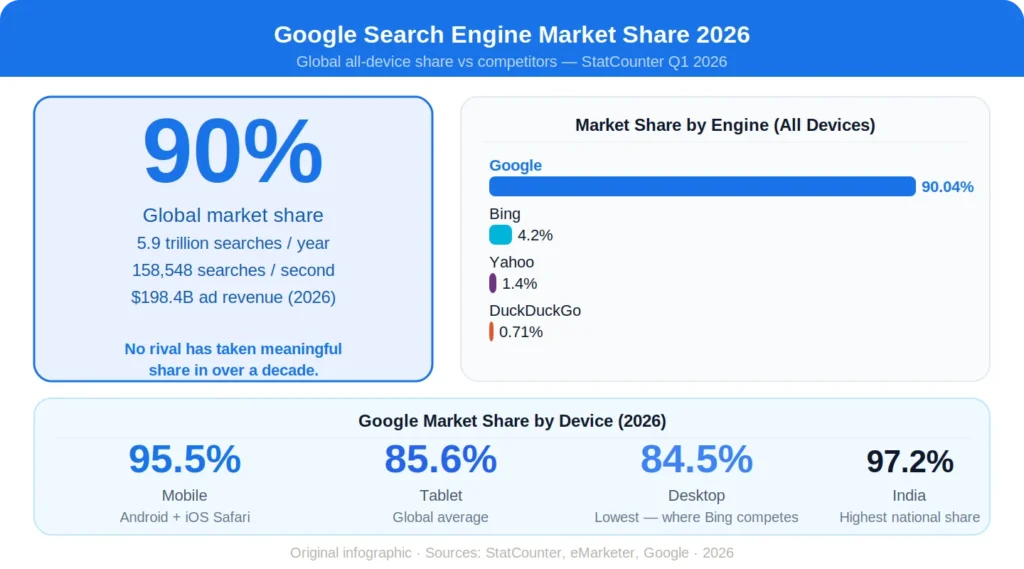
Why does Google dominate search engine markets at a scale that no other technology company has matched in any comparable category? The numbers tell the story before the explanations do.
<cite index=”13-1″>In 2026, Google’s global search market share has reached 91.4%, according to Statcounter’s Q1 2026 Global Search Engine Market Report, despite intensified competition from Microsoft’s AI-integrated Bing platform, which grew its share modestly to 4.2%, and Perplexity AI, which captured approximately 1.1% of global search traffic.</cite>
Here is the full competitive breakdown as of mid-2026:
| Search Engine | Global Market Share (All Devices) |
|---|---|
| 90.04–91.4% | |
| Bing | 4.2–5.03% |
| Yahoo | 1.40–1.45% |
| Yandex | 0.99–1.84% |
| DuckDuckGo | 0.71–0.89% |
| Baidu | 0.53% |
<cite index=”15-1″>According to Google’s own 2025 count, it handles more than 5 trillion searches per year, about 14 billion per day and roughly 158,548 per second.</cite>
<cite index=”17-1″>Google processes over 5 trillion searches per year, totalling about 16.4 billion searches daily, more than 11.4 million searches per minute, and over 189,815 searches per second.</cite>
The gap between Google and every competitor is not close — it is structural. Why does Google dominate search engine markets so completely? Seven interconnected reasons explain it, each reinforcing the others.
Reason 1 — The Default Effect and Paying to Be First
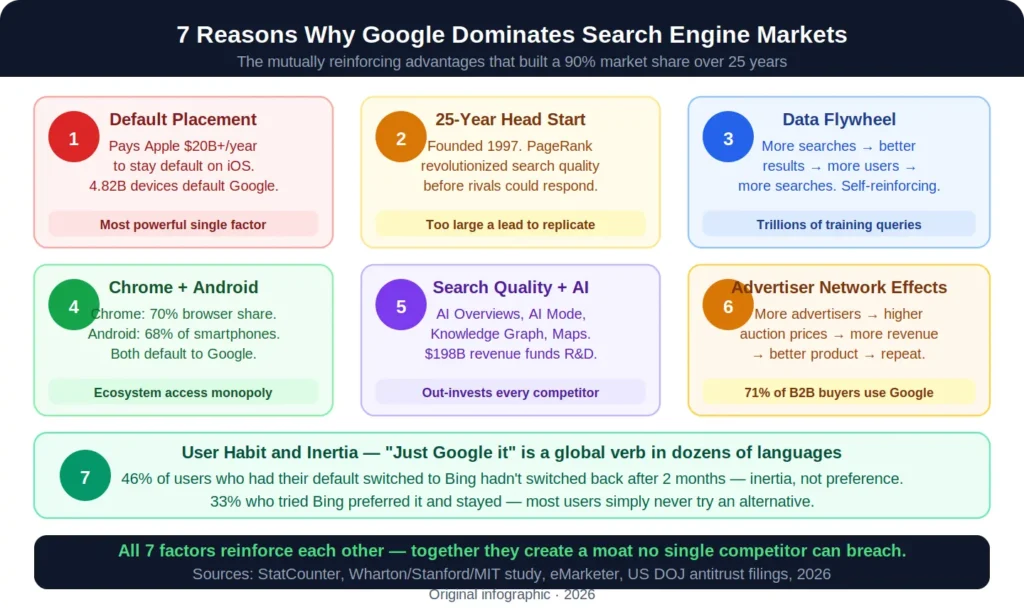
The single most powerful explanation for why does google dominate search engine markets globally is not algorithmic superiority — it is default placement backed by billions of dollars in agreements to stay there. Understanding why does google dominate search engine defaults is the key to understanding the whole market.
<cite index=”11-1″>A recent study co-authored by Wharton professor Leon Musolff challenges the assumption that Google’s dominance is purely a result of superior quality. Musolff finds that many users stick with Google simply because they never explore other options — and when they do, some choose to stay with a competitor.</cite>
<cite index=”11-1″>Most devices and browsers come with a default search engine. “Even though technically you have the choice, you don’t have what we would call an ‘active choice,’ because you are basically just following the default that was set,” said Musolff.</cite>
The economics behind this default position are staggering. <cite index=”19-1″>Google pays Apple an estimated $20 billion or more annually to remain the default search engine on iOS Safari.</cite> This single payment — revealed through the antitrust proceedings — represents one of the most expensive default agreements in tech history, and it is just one of dozens of similar arrangements with device manufacturers, browser developers, and mobile carriers worldwide.
<cite index=”15-1″>Around 4.82 billion devices use Google as their default search engine, and StatCounter data shows Android powers about 68% of the world’s smartphones with Google Search built in, while Chrome holds over 70% of the browser market with Google as its default.</cite>
Why does Google dominate search engine usage through defaults so effectively? Because <cite index=”20-1″>Google’s market share is not just the result of consumers actively preferring it — many users simply never experience an alternative due to its default position.</cite>
The Wharton study produced a striking result: <cite index=”20-1″>when users’ default search engine was changed from Google to Bing, after two months, 46% had not switched back — showing persistent inattention as a major factor in market share retention.</cite> Inertia, not preference, keeps hundreds of millions of people on Google every day.
Reason 2 — A 25-Year Head Start and Unmatched Scale
Why does Google dominate search engine technology? Because it has been building it for over 25 years at a scale no competitor has matched.
Google launched in 1997. Its algorithm — PageRank — was revolutionary at the time, evaluating web pages not just by content but by the quality and quantity of links pointing to them. While Yahoo relied on human-curated directories and AltaVista indexed pages by keyword frequency, Google’s link-based ranking system produced dramatically better results. That early quality advantage compounded into market dominance before any meaningful competitor could mount a response.
<cite index=”12-1″>Ever since the introduction of Google Search in 1997, the company has dominated the search engine market, while the shares of all other tools has been rather lopsided.</cite>
The scale advantage that accumulated over those 25 years is almost impossible to replicate. Google has crawled and indexed hundreds of billions of web pages. It has refined its algorithm through trillions of searches worth of behavioral signals — which queries get clicked, which results users return from, which pages users stay on. Every search that runs through Google makes the next search marginally better.
Why does Google dominate search engine indexing? Because no competitor has had the time, the capital, or the user volume to build an equivalent dataset. Bing has been trying since 2009, with Microsoft’s full resources behind it, and it still holds only 4–5% of global market share. The head start is simply too large.
Reason 3 — The Data Flywheel Advantage
Why does Google dominate search engine quality? The data flywheel — one of the most powerful self-reinforcing competitive advantages in technology.
Why does google dominate search engine quality through this mechanism? The flywheel works like this: more searches produce more behavioral data. More behavioral data enables better results. Better results attract more users. More users produce more searches. The cycle accelerates continuously, leaving competitors structurally behind.
Google has processed trillions more searches than any competitor over its 25-year history. Each one generated signals: which result a user clicked, how long they stayed on the page, whether they came back to search again (indicating the first result didn’t satisfy them), what related queries followed. These signals trained Google’s ranking algorithms to an extraordinarily fine degree of precision that no competitor can replicate without equivalent data.
Why does Google dominate search engine results for rare and complex queries? Because it has seen those queries before — millions of times — and learned from how users responded to previous results. A new search engine, even one with a theoretically superior algorithm, has no historical signal data to learn from. It must build that dataset from scratch, in real time, while competing against an engine with decades of accumulated intelligence.
The data flywheel also extends to advertising. Google’s ability to precisely target and measure advertising performance — built on the same behavioral data — makes its ad platform dramatically more effective than alternatives. This creates a second flywheel: better ad performance attracts more advertisers, more ad revenue funds more infrastructure investment, better infrastructure enables better search, and the cycle continues.
Reason 4 — Chrome, Android, and Ecosystem Lock-In
Why does Google dominate search engine access points? Because it controls the infrastructure through which most of the world accesses the internet.
<cite index=”15-1″>Chrome holds 70.25% of the global browser market and ships with Google as the default.</cite> Every Chrome user who types a query into the address bar sends it to Google by default — with zero friction required. Changing the default requires deliberate action most users never take.
Android is the second pillar. <cite index=”17-1″>More than 5 billion people worldwide use Google, reflecting its dominance in its global reach and the central role it plays in how people search, learn, and access information every day.</cite> Android powers approximately 68% of the world’s smartphones, and Google Search is baked directly into the operating system — available from the home screen, the notification bar, and the voice assistant.
Why does Google dominate search engine access on mobile so completely? <cite index=”15-1″>As of April 2026, Google accounted for 95.52% of the global mobile search engine market worldwide.</cite> The combination of Android’s market leadership and Chrome’s browser dominance creates an access-point monopoly that is extraordinarily difficult for competitors to penetrate.
Why does google dominate search engine access through this ecosystem? Beyond Chrome and Android, Google creates additional lock-in through: Gmail integrates with Google Search for web queries. Google Maps is the default navigation tool on billions of devices. YouTube is both a standalone platform and a search engine in its own right, with Google Search results frequently surfacing YouTube content. Google Photos, Google Docs, Google Drive, and the entire Google Workspace suite all funnel users toward Google Search as the default web discovery tool.
Why does Google dominate search engine queries across all these surfaces? Because every product in Google’s ecosystem is another touchpoint that defaults to Google Search — and leaving the ecosystem requires simultaneously replacing a browser, a mobile OS, a navigation app, an email client, a video platform, and a document suite.
Reason 5 — Superior Search Quality and Continuous Innovation
While default placement is the most powerful single factor in why does Google dominate search engine markets, it would be wrong to dismiss quality as irrelevant. Google’s search quality is genuinely excellent — and it has invested relentlessly in maintaining that advantage.
Why does google dominate search engine results pages with rich features? Google’s Knowledge Graph, launched in 2012, answers factual queries directly without requiring a click. Featured snippets, People Also Ask boxes, local results, image search, shopping integration, maps integration, and now AI Overviews all represent quality improvements that make Google search results more useful than a simple list of blue links.
<cite index=”13-1″>The expansion of AI-powered features, such as Google’s AI Overviews, is projected to drive 30% higher engagement rates in personalized search results.</cite>
Google’s investment in AI is enormous. Its AI Mode, launched in mid-2025, stabilized its market share after a period of modest decline by offering conversational search capabilities directly within the results page — reducing the perceived need for users to switch to ChatGPT or Perplexity for AI-powered answers.
Why does Google dominate search engine innovation despite being a 25-year-old company? Because it has the resources — $198.4 billion in search advertising revenue in 2026 — to out-invest every competitor simultaneously. No rival can match Google’s R&D budget, talent pool, infrastructure investment, or the pace of its algorithm updates.
Reason 6 — Advertiser Network Effects
Why does Google dominate search engine advertising so completely? Network effects on the advertiser side create a self-reinforcing advantage that is as powerful as the user-side flywheel.
<cite index=”13-1″>In 2026, Google’s search advertising revenue is projected to reach $198.4 billion, according to eMarketer’s Global Digital Ad Spending Forecast, representing a 23.9% increase over its 2025 figure.</cite>
Why does google dominate search engine advertising through network effects? More advertisers competing for search inventory drives up ad auction prices, which increases Google’s revenue. Higher revenue funds better infrastructure and algorithm development. Better search quality attracts more users. More users make the advertising platform more valuable. More valuable advertising attracts more advertisers. The cycle is self-reinforcing.
Why does Google dominate search engine advertising rather than alternatives? Because the network effect has produced such a deep concentration of advertiser demand, budget, and optimization expertise around Google Ads that switching to an alternative platform means starting from scratch — new campaigns, new audiences, new bidding strategies, new quality scores — with dramatically less traffic and less precise targeting data.
<cite index=”17-1″>About 71% of B2B customers rely on search engines to do product research</cite> — and the vast majority of that research happens on Google. For B2B advertisers, this is not a matter of preference; it is a matter of being present where their buyers actually are.
Reason 7 — User Habit and Inertia
The final reason why does google dominate search engine usage at such scale is the simplest and perhaps the most durable: habit. Habit is why does google dominate search engine mind share in ways that data alone cannot explain.
Hundreds of millions of people have used Google as their primary search engine for 15 to 25 years. The word “Google” has become a verb in dozens of languages. “Just Google it” is a global cultural shorthand for finding any information online. This linguistic and behavioral embedding runs deeper than any technical switching barrier.
<cite index=”20-1″>Users tend to stick with Google not because they have tried Bing and rejected it, but because they have never meaningfully experienced it.</cite>
<cite index=”20-1″>When users are required to actively choose a search engine, very few switch away from Google. However, when users experience Bing for two weeks, a significant number update their preferences and continue using it.</cite> Specifically, <cite index=”11-1″>when paid to use Bing, 58% switched, and 33% of them stuck with the Microsoft alternative even after the experiment ended.</cite>
This finding is significant: a third of users who genuinely tried Bing preferred it and stayed with it. Why does Google dominate search engine usage among people who have never tried an alternative? Not because Google is categorically better, but because the default setting, combined with years of habit, means most users never take the 60 seconds required to find out.
Google’s Dominance by Device and Region
Why does Google dominate search engine markets unevenly across different devices and geographies? Because the factors driving dominance vary by context.
By device:
- Mobile: <cite index=”15-1″>Google accounted for 95.52% of the global mobile search engine market as of April 2026</cite> — its strongest platform, locked in by Android defaults and Chrome mobile
- Tablet: 85.58% global share (StatCounter, May 2026)
- Desktop: 84.49% global share — its weakest platform, where Bing holds approximately 10% and competing engines make their best showing
By country:
- India: 97.18% — highest among major markets; virtually no meaningful alternative presence
- Nigeria: approaches 98.69% — near-total monopoly
- United States: 85.05% — its most competitive major market, reflecting a more tech-savvy population more likely to switch defaults
- Japan: approximately 72% — one of the most competitive developed markets, with Yahoo Japan (powered by Google) and Bing sharing meaningful share
- Russia: Yandex holds approximately 60% — one of the only major markets where Google never established dominance
- China: Baidu controls approximately 53% — the other market where domestic regulation and culture limited Google’s expansion
<cite index=”19-1″>Mobile is now where 64% of all global queries happen, and Google’s mobile lock is tighter: on mobile devices Google holds approximately 94.6% share globally — substantially higher than its desktop share.</cite>
The Antitrust Battle Over Google’s Dominance
Why does Google dominate search engine markets despite antitrust law? Because until recently, regulators were slow to act — and Google’s legal team was formidable. But the landscape is shifting.
<cite index=”11-1″>In August 2024, a U.S. judge ruled Google illegally maintained its search monopoly by paying companies like Apple to keep it as the default, blocking fair competition.</cite> This ruling — the result of the U.S. Department of Justice’s antitrust case against Google — was one of the most significant antitrust decisions in the history of the technology industry.
The DOJ’s case centered on exactly the mechanism described in Reason 1: Google’s billions of dollars in default placement agreements with Apple, Samsung, Mozilla, and others. The argument was that these agreements constituted illegal monopoly maintenance — not by making Google better, but by ensuring competitors could never get the user exposure needed to compete.
The remedies being considered include forcing Google to divest its Chrome browser, prohibiting default search agreements, or mandating a choice screen where users actively select their preferred search engine during device or browser setup.
The EU has gone further, mandating choice screens in the European Economic Area under the Digital Markets Act — which is why Chrome in the EEA now shows a ballot screen during setup. Initial data indicates these screens have a small impact in reducing Google’s market share, with the main winners being DuckDuckGo and Bing.
Why does Google dominate search engine regulation debates globally? Because its scale has made it the test case for how democratic societies will govern platform monopolies in the 21st century. The outcomes of these cases in the US, EU, UK, and India will shape the competitive landscape for search for the next decade.
Is Google’s Dominance Under Threat in 2026?
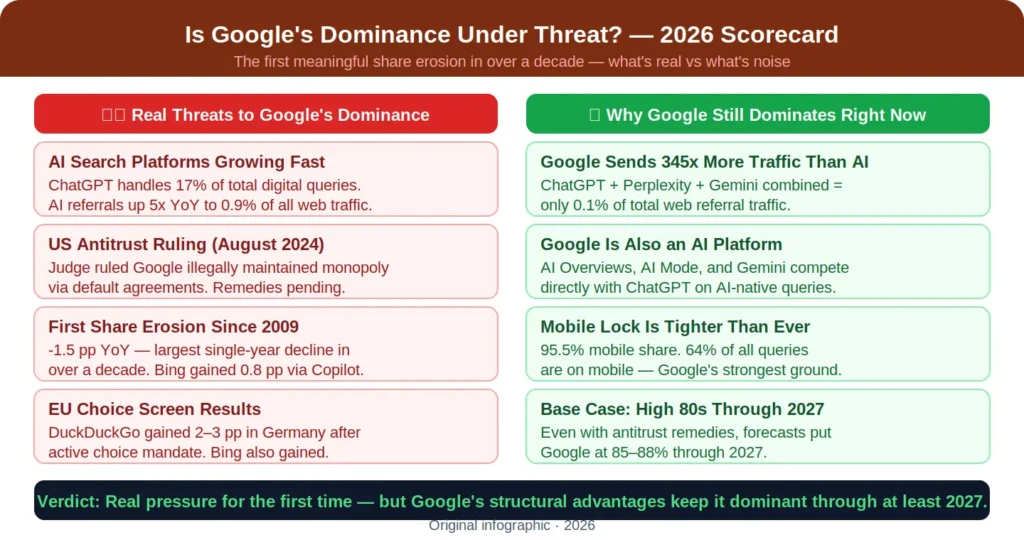
Why does Google dominate search engine markets despite growing AI competition? The honest answer is: for now, its lead is secure — but the structural trends are worth monitoring.
<cite index=”19-1″>Google’s all-device share dropped roughly 1.5 percentage points year-over-year — the largest single-year erosion since 2009. The lost share was distributed across Bing (+0.8 percentage points on the back of Copilot integration), AI search assistants (+0.7 percentage points), and a fractional Yandex recovery in CIS markets.</cite>
<cite index=”14-1″>First Page Sage’s Q4 2025 report estimated that ChatGPT now handles 17% of total digital queries globally, with Google retaining roughly 80% once AI platforms are counted alongside traditional search engines. An Adobe Express survey found that 77% of Americans had used ChatGPT as a search tool, and 24% said they turn to it before Google.</cite>
However, perspective is required. <cite index=”15-1″>Google sends 345 times more traffic to websites than ChatGPT, Gemini, and Perplexity combined, and AI tools account for about 0.1% of all web referral traffic.</cite>
<cite index=”18-1″>Of Google’s 8.5 billion daily searches, 5.5 billion don’t result in a click to an external website — Google answers the query itself.</cite> This zero-click phenomenon means Google is also competing with itself — keeping users inside its own ecosystem rather than sending them to external publishers.
Why does Google dominate search engine futures despite AI disruption? Because it is both a traditional search engine and an AI search platform simultaneously. Its AI Overviews, AI Mode, and Gemini integration allow it to compete directly with ChatGPT and Perplexity on their own turf — while still controlling the default placement agreements, the browser, the mobile OS, and the 25-year behavioral dataset that no AI startup can replicate.
Examples and Case Studies
Example 1 — The Default Switch Study
Researchers from Stanford, MIT, and the University of Pennsylvania ran a controlled experiment: they temporarily changed participants’ default search engines from Google to Bing and observed behavior over two months.
The results directly answer why does Google dominate search engine markets: <cite index=”20-1″>64% of participants who actively decided to keep using Bing reported that it was better than expected, and 59% reported that they had gotten accustomed to using Bing.</cite>
The implication is profound: Google’s dominance is partially artificial — sustained by defaults rather than merit. When users actually try alternatives, a meaningful portion prefers them. But because most users never try alternatives, Google’s market share remains near-total.
Example 2 — Why Google Dominates in India at 97%
India provides the clearest case study of default-driven dominance. With Android powering over 95% of Indian smartphones — all defaulting to Google — and Chrome dominating the browser market, the average Indian internet user has never meaningfully encountered an alternative search engine. <cite index=”14-1″>India records the highest national Google share at 97.18%</cite> — not because Indians are particularly loyal to Google, but because the hardware and software ecosystem leaves virtually no exposure pathway to alternatives.
Example 3 — Russia and China: Where Google Doesn’t Dominate
The clearest evidence that why does Google dominate search engine markets is not inevitable comes from Russia and China — the two major markets where it doesn’t. In Russia, Yandex built a local search engine that understood the Russian language and culture better than Google’s initial efforts, and gained early traction before Google could establish default agreements. In China, government regulation blocked Google entirely, allowing Baidu to establish the defaults Google enjoys everywhere else.
These exceptions prove the rule: without default placement, Google does not automatically win. The defaults are the moat.
Case Studies
Case Study 1 — Apple’s $20 Billion Default Agreement
Background: Through the US antitrust trial against Google, it emerged that Google pays Apple approximately $20 billion per year to remain the default search engine in Safari on iPhone, iPad, and Mac.
Scale of the agreement: This payment accounts for an estimated 14–16% of Apple’s total annual profits and represents one of the largest commercial agreements in technology history. Apple’s Services revenue — which Wall Street analysts rate at premium multiples — is substantially dependent on this Google payment.
The implication for why does Google dominate search engine markets: Google’s dominance on iOS is essentially purchased. Every iPhone user who has never changed their Safari default is generating search revenue for Google — not because they chose Google, but because Apple chose it for them in exchange for $20 billion.
Key takeaway: Why does google dominate search engine usage on Apple devices? Because Apple is paid $20 billion annually. This is the clearest single answer to why does google dominate search engine markets on iOS — money, not merit alone. This arrangement is now the subject of US antitrust remedies that may prohibit such agreements going forward.
Case Study 2 — The EU Choice Screen Experiment
Background: Under the EU’s Digital Markets Act, Google was required to implement a search engine choice screen in Europe — a ballot that appears during browser or device setup and asks users to actively select their preferred search engine.
Results: Early data from EEA markets shows modest but real share shifts. DuckDuckGo’s share in Germany and the Netherlands increased approximately 2–3 percentage points following the choice screen mandate. Bing saw smaller but measurable gains. Google’s share dipped in these markets while remaining dominant.
What this proves: When users are forced to make an active choice — even once, at setup — they distribute across alternatives at higher rates. Why does Google dominate search engine markets everywhere else? Because everywhere else, the choice is made for them.
Key takeaway: The EU experiment is the closest real-world test of what search competition would look like without default agreements. The results suggest Google would still be the largest engine — but with 70–80% share rather than 90%+.
Best Tools for Tracking Search Engine Market Share
| Tool | What It Measures | Price |
|---|---|---|
| StatCounter Global Stats | Real-time search engine market share by device, country, and platform | Free |
| Statista | Historical and current market share with data visualization | Free / Premium |
| SimilarWeb | Search referral traffic and competitive benchmarking | Free / From $149/month |
| SparkToro | Zero-click search rates and traffic source analysis | From $40/month |
| SEMrush Market Explorer | Competitive market share analysis by category | From $139.95/month |
| Ahrefs | Organic search traffic by engine, keyword, and domain | From $129/month |
| Google Search Console | Your site’s performance specifically in Google Search | Free |
| BrightEdge | Enterprise AI visibility and SERP feature tracking | Enterprise pricing |
For the most comprehensive ongoing analysis of why does Google dominate search engine markets and how the landscape is evolving, Search Engine Land and Search Engine Journal publish the most thoroughly researched market share reporting available to the public.
Common Misconceptions About Why Google Dominates
Misconception 1: Google dominates purely because it has the best algorithm The Wharton/Stanford/MIT research shows this is at most a partial truth. When users try alternatives, a significant minority prefer them. Default placement — not algorithmic superiority — is the primary driver of Google’s market share. Why does Google dominate search engine results pages? Partly quality, but more importantly: it’s the only engine most users have ever used.
Misconception 2: Switching to another search engine is too difficult <cite index=”20-1″>Google’s continued dominance cannot be explained by the idea that switching search engines is too difficult for users.</cite> Switching takes less than 60 seconds in any browser. The barrier is not technical — it is behavioral. Users simply don’t think about it.
Misconception 3: Google’s dominance is invincible It is powerful but not permanent. Russia and China show it can be disrupted by regulation and early-mover alternatives. The EU choice screen shows active choice reduces Google’s share. Antitrust remedies in the US could force default agreement prohibitions that meaningfully reshape the market.
Misconception 4: AI will quickly erode Google’s dominance <cite index=”15-1″>Traditional search still drives about 30 times more traffic than AI search tools.</cite> AI search is growing rapidly but from a tiny base. Google is also an AI search platform itself, with Gemini, AI Overviews, and AI Mode all competing directly with external AI tools. The transition will be gradual — not the overnight disruption some predict.
Misconception 5: Bing is a failed product Bing processes billions of searches per day. It holds 10%+ of desktop search in the US and UK. DuckDuckGo, Yahoo, and others all run on Bing’s index. Why does Google dominate search engine markets compared to Bing despite all this? Because Bing’s real share is being undersold by how it is measured — but it remains structurally limited by the default agreements that channel users to Google before Bing ever gets a chance.
FAQs
Q: Why does Google dominate search engine markets with 90%+ share? Seven interconnected factors explain it: default placement agreements (paying Apple $20B+ annually), a 25-year head start and unmatched data scale, the data flywheel advantage, Chrome and Android ecosystem control, genuine search quality, advertiser network effects, and deep user habit and inertia. No single factor alone would produce 90% market share — all seven together do.
Q: Is Google’s search dominance due to quality or defaults? Both — but research from Stanford, MIT, and the University of Pennsylvania suggests defaults play a larger role than most people assume. When users actively try Bing, 33% prefer it and stay with it. Most users have simply never been exposed to an alternative because Google has paid billions to ensure it is always the default.
Q: Can anything challenge why Google dominates search engines? Three forces are creating real — if incremental — pressure: AI search platforms (ChatGPT, Perplexity, Gemini) are capturing query volume, particularly for conversational and research queries; antitrust rulings in the US and EU may prohibit default agreements; and Bing’s AI-powered Copilot integration has grown its desktop market share meaningfully. None represents an imminent threat to Google’s overall dominance, but the trajectory of the past year is the weakest Google has seen in over a decade.
Q: Why does Google dominate search engine markets in some countries more than others? The degree of dominance correlates closely with the penetration of Android devices and Chrome browsers — which default to Google. In markets where Android is near-universal (India at 97%+ Google share), alternatives have essentially no presence. In markets where iOS and other browsers compete more strongly (US at 85%), Google’s share is lower. In markets with domestic alternatives that established early defaults (Russia, China), Google never achieved dominance.
Q: Does Google’s dominance hurt consumers? The antitrust argument is that it does — by reducing the investment and innovation that competition would produce, and by allowing Google to charge higher advertising prices than a competitive market would support. The counterargument is that Google’s search quality is genuinely excellent and free to use. Both can be simultaneously true.
Q: What happens to SEO if Google’s dominance erodes? SEO strategy would need to expand to cover multiple surfaces — Google, Bing, AI Overview citations, Perplexity, ChatGPT Search, and others. This “Search Everywhere Optimization” framework is already becoming standard practice for the most sophisticated digital marketing teams. Why does Google dominate search engine SEO investment? Because 90% market share means 90% of the ROI from search optimization. If that share shifts to 75%, Bing and AI platforms become significantly more important to optimize for.
Conclusion
Why does Google dominate search engine markets with such extraordinary, sustained totality? Because seven mutually reinforcing advantages — defaults, scale, data, ecosystem control, quality, advertiser networks, and habit — have compounded over 25 years into a competitive position that is extraordinarily difficult to disrupt.
Why does Google dominate search engine usage so completely that billions of people never meaningfully use an alternative? Because the technical barrier to switching is minimal but the behavioral and structural barriers are enormous. Google is the default. It is what the browser opens. It is what the phone uses. It is the word people use as a verb. That cultural and infrastructural embedding is worth more than any algorithm.
And yet — the trajectory has shifted. The first meaningful share erosion in over a decade is underway. Antitrust remedies in the US and EU are forcing structural changes to the default agreements that built Google’s dominance. AI search platforms are growing 5x year-over-year in referral traffic. The question of why does Google dominate search engine markets is beginning to give way to a more interesting question: for how much longer, and by how much?
For businesses and marketers, the answer to why does google dominate search engine strategy is clear: optimize for Google today because it still controls 90% of search. But build for multi-surface visibility tomorrow — because the search landscape of 2030 will be more competitive than the one we have now.
Related Reading: Is SEO Dead? The Brutally Honest, Data-Driven Answer | What Are SEO Keywords? The Proven Guide
Actionable Takeaways
✅ Understand the default effect — why does Google dominate search engine usage on your devices? Because it was set as the default. Test an alternative for two weeks and see if your perception changes.
✅ Build your SEO strategy around Google’s 90% share — but start tracking your visibility in Bing, DuckDuckGo, and AI Overviews now. The SEO team that waits until Google’s share drops to 80% to diversify will be two years behind.
✅ Implement schema markup — structured data makes your content more citeable across all search surfaces, including AI Overviews. Why does Google dominate search engine rich results? Because sites with schema get featured more often.
✅ Monitor AI search referrals — set up traffic source tracking in your analytics to see referrals from ChatGPT, Perplexity, and Gemini. Even at 0.9% of referral traffic, these visitors browse more pages and bounce less than average.
✅ Watch the antitrust proceedings — US DOJ remedies against Google’s default agreements could reshape search defaults within 2–3 years. Businesses heavily dependent on Google organic traffic should have a diversification plan.
✅ Optimize for Google AI Overviews — cited brands earn 35% more organic clicks. Why does Google dominate search engine traffic distribution so unevenly? Because AIO citations multiply the advantage of already-authoritative sites.
✅ Don’t overlook Bing for B2B — Bing holds over 10% of US desktop search. For B2B businesses targeting desktop-primary professional audiences, Bing Ads and Bing SEO offer less competition and lower CPCs at meaningful reach.