Introduction
How to create backlinks is the question behind every serious SEO strategy — and for good reason. Backlinks remain one of Google’s top three ranking factors in 2026, and the gap between websites that know how to create backlinks effectively and those that don’t is enormous and widening.
And how broad is that? 95.2% of all indexed content has no external backlinks. Pages that rank high on Google have 3.8x more backlinks than pages that rank 2nd to 10th. 73.2% of marketers think backlinks impact the likelihood of ranking in AI search results from ChatGPT and other LLMs. Companies that have learned how to generate backlinks not only rank better on Google, but they are also cited more often by AI systems such as Perplexity, Google AI Overviews, and even ChatGPT.
But how to create backlinks has fundamentally changed. The spray-and-pray link schemes of 2018 are not only ineffective in 2026 — they actively trigger ranking penalties. What works now is harder, more strategic, and far more rewarding: earning links through genuine authority, original content, and real relationships.
In this guide you’ll learn:
- What backlinks are and why they matter more than ever in 2026
- How to create backlinks using 12 proven strategies
- The types of backlinks you should be building — and avoiding
- Step-by-step instructions for each method
- Real case studies and tools to accelerate your results
Related Reading: What Are SEO Keywords? The Proven Guide | Is SEO Dead? The Brutally Honest Answer
Table of Contents
- What Are Backlinks?
- Why Backlinks Are Critical in 2026
- Types of Backlinks — What Counts and What Doesn’t
- How to Create Backlinks — 12 Proven Strategies
- How to Create Backlinks Step by Step
- Examples of Backlink Building in Action
- Case Studies
- Best Tools for Building Backlinks
- Common Mistakes When Creating Backlinks
- FAQs
- Conclusion
- Actionable Takeaways
What Are Backlinks?
A backlink is a link from one website pointing to another. When Site A links to a page on Site B, Site B has earned a backlink from Site A. Backlinks are also called inbound links, incoming links, or external links.
Search engines like Google treat backlinks as votes of confidence. When a high-authority, relevant website links to your page, it signals to Google that your content is trustworthy, useful, and worth showing to more people. The more high-quality backlinks your page earns, the more authority Google assigns to it — and the higher it tends to rank.
How to create backlinks effectively comes down to one core principle: make your content so valuable that other websites genuinely want to reference it. Every other strategy in this guide flows from that principle.
Why Backlinks Are Critical in 2026
Before diving into how to create backlinks, it’s worth understanding the scale of the opportunity — and the risk of ignoring it.
Backlinks are still a top-3 Google ranking factor. Despite over a decade of predictions that Google would eventually devalue links, they remain among the most powerful signals in the algorithm. Google and other search engines now utilize backlinks to verify a webpage’s usefulness, determining if it should reach broader audiences.
The gap between linked and unlinked content is staggering. 94% of online content fails to secure any external links, with only 2.2% successfully acquiring them. This means that learning how to create backlinks puts you in a small, elite category that the majority of websites never reach.
Backlinks now drive AI visibility as well as search rankings. Quality backlinks still matter for rankings and authority. In 2026, they also help you show up in AI answers across Google AI Overviews, Perplexity, ChatGPT, and Gemini. When relevant sources link to you and mention you alongside specific topics, AI systems begin to associate your brand with those areas.
Original research earns dramatically more links. Original research reports and data-driven studies now attract 6.4 times more backlinks than opinion-based articles, with interactive data visualizations earning an average of 487 referring domains per piece.
Long-form content is a proven link magnet. Articles exceeding 3,000 words garner 3.5 times more backlinks than shorter content. Posts with more than three videos draw 55% more backlinks.
Digital PR has become the dominant strategy. Digital PR has emerged as the clear leader in link building effectiveness, with 67.3% of marketers now using digital PR as their primary link building method.
Types of Backlinks — What Counts and What Doesn’t
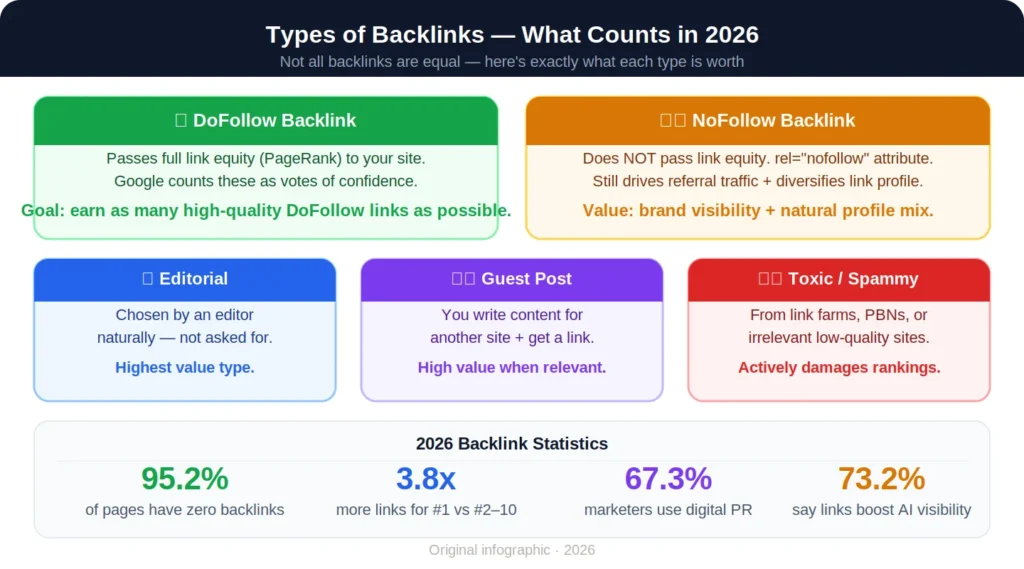
Not all backlinks are equal. Before you learn how to create backlinks, you need to understand which types actually help — and which can harm you.
DoFollow Backlinks
The most valuable type. A DoFollow link passes “link equity” (also called PageRank or “link juice”) from the referring site to yours. When a high-authority website gives you a DoFollow link, Google counts it as a strong vote of confidence. These are what every link-building strategy is primarily aimed at earning.
NoFollow Backlinks
A NoFollow link contains a rel="nofollow" attribute that tells Google not to pass link equity. These don’t directly improve rankings, but they do drive referral traffic, diversify your link profile, and build brand visibility. A natural backlink profile includes a healthy mix of both types.
Sponsored / UGC Links
Links marked rel="sponsored" or rel="ugc" signal paid placements or user-generated content. Google does not count these as editorial endorsements. Never pay for links without using these attributes — doing so violates Google’s guidelines.
Editorial Links
The gold standard. An editorial backlink is one that a website’s editor chose to include naturally because your content was genuinely valuable or cited. These are the most powerful links you can earn and the ultimate goal of knowing how to create backlinks properly.
Low-Quality / Toxic Links
Links from spammy, irrelevant, or low-authority sites — link farms, private blog networks (PBNs), or sites built purely to sell links — can actively damage your rankings. Google’s Spam algorithms in 2025 and 2026 are highly effective at detecting and discounting or penalizing these. Avoid them entirely.
How to Create Backlinks — 12 Proven Strategies
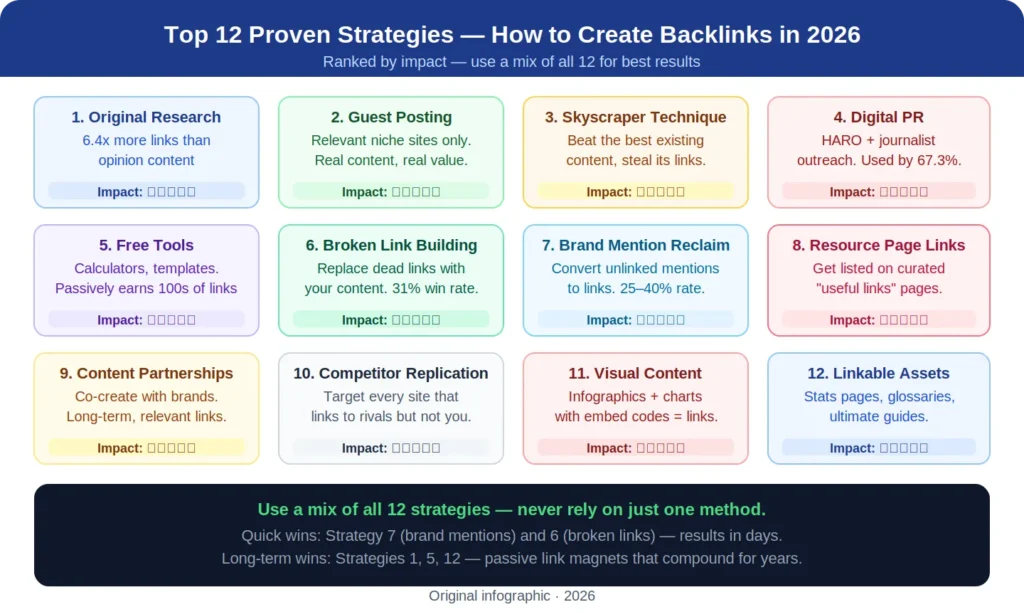
Here are the 12 most effective strategies for how to create backlinks in 2026, ranked from highest to most accessible impact.
Strategy 1 — Publish Original Research and Data
Original research reports and data-driven studies now attract 6.4 times more backlinks than opinion-based articles. When you publish proprietary data — a survey of your customers, an analysis of your industry, or a unique dataset compiled from public sources — other writers, journalists, and bloggers need to cite you as the source every time they reference your findings.
How to create backlinks with original research:
- Survey your audience or customer base on a relevant industry topic
- Analyze publicly available data from government, industry, or academic sources
- Publish your findings as a named annual report (e.g., “State of [Your Industry] 2026”)
- Distribute the report through PR outreach to journalists and industry publications
- Update the report annually to keep earning citations year after year
Why it works: Every time someone references your data, they link to you. One well-promoted research report can generate dozens or hundreds of links passively over months.
Strategy 2 — Guest Posting on Authoritative Sites
Guest posting remains one of the most reliable ways to learn how to create backlinks at scale — when done correctly. Guest posting still works in 2026 when done the right way. The goal is not to “place a link,” but to contribute useful content to a relevant audience.
How to create backlinks through guest posting:
Step 1: Search Google for [your niche] + "write for us" or [your niche] + "guest post" to find sites that accept contributions.
Step 2: Evaluate each site — check its Domain Rating (DR) in Ahrefs, ensure it has real traffic, and confirm it’s relevant to your niche.
Step 3: Pitch a topic that provides genuine value to their audience — not a thin article designed purely to insert a link.
Step 4: Write the best article you’ve ever written for their audience. Include your link naturally in the body where it genuinely adds value.
Step 5: After publication, build on the relationship. A single guest post can lead to recurring opportunities and additional editorial mentions.
What to avoid: In 2026, duplicate content will be ineffective. Therefore, it is better to do an industry-name + “write for us” search, connect with the websites you find, and pitch a relevant topic. Never submit the same article to multiple sites.
Strategy 3 — The Skyscraper Technique
The Skyscraper Technique is one of the most proven methods for how to create backlinks at scale. Find highly popular content in your field. Does it have lots of backlinks? Great! Now, create a version for your site that is much better, more in-depth, and features original content, such as statistics. Once this content goes live, reach out to the initial content’s backlinks and suggest linking to you instead of (or in addition to) the other site.
How to create backlinks with the Skyscraper Technique:
Step 1: Use Ahrefs or Semrush to find a piece of content in your niche with many backlinks pointing to it.
Step 2: Analyze what the content does well — and where it falls short. Is it outdated? Does it lack data? Is the design poor? Is it missing key subtopics?
Step 3: Create a significantly better version. More comprehensive, more current, better designed, backed by more data.
Step 4: Export the list of sites linking to the original content. Reach out to each one and let them know you’ve published a more complete, up-to-date resource.
Step 5: Follow up once. Many sites will update their links to the better resource.
Strategy 4 — Digital PR and Journalist Outreach
Digital PR has emerged as the clear leader in link building effectiveness. 48.6% of SEO professionals consider digital PR the most effective link-building tactic. A single editorial link from a major publication — Forbes, TechCrunch, The Guardian — is worth more than hundreds of average directory or blog links.
How to create backlinks through Digital PR:
- Register on HARO (Help a Reporter Out), Qwoted, or SourceBottle. Journalists actively request expert quotes daily — responding to relevant queries earns editorial links from high-authority publications.
- Pitch original data and stories to industry journalists. A unique statistic from your own research is exactly what journalists are looking for.
- Newsjack trending stories in your industry. When a relevant news story breaks, reach out to journalists covering it with a unique expert angle.
- Participate in webinars, industry panels, and niche podcasts. These spaces usually link to expert guests on their landing pages, speaker bios, or episode show notes — credible and highly relevant backlinks.
Strategy 5 — Build Free Tools, Calculators, and Templates
Free tools that solve real problems are crushing it in 2026. ROI calculators, assessment tools, interactive quizzes, and comparison engines naturally attract backlinks because they provide utility beyond simple content consumption.
One financial services company created a retirement planning calculator that earned over 1,200 backlinks in its first year — with minimal promotion — because financial advisors, personal finance bloggers, and educational sites found it genuinely useful.
How to create backlinks with free tools:
- Identify a calculation or process your audience does manually and automate it
- Build a free template library (spreadsheets, checklists, frameworks)
- Create an interactive quiz that produces personalized results
- Launch a lightweight free version of a capability your paid product offers
Strategy 6 — Broken Link Building
Broken link building is one of the most underrated methods for how to create backlinks — and one of the most reliably successful. The approach: find broken links on other websites pointing to dead pages, then offer your content as a replacement.
How to create backlinks with broken link building:
Step 1: Use Ahrefs’ “Broken Backlinks” report or Chrome extension Check My Links to find broken links on relevant websites in your niche.
Step 2: Verify that the broken link was pointing to content similar to something you already have — or can create.
Step 3: Email the site owner. Inform them of the broken link (framing it as doing them a favor), and suggest your content as a suitable replacement.
Why it converts: You’re solving a problem for the site owner (a broken link is bad UX and bad SEO), so your pitch has immediate value beyond just asking for a link.
Strategy 7 — Unlinked Brand Mention Reclamation
One of the fastest ways to create backlinks is to convert mentions you already have. Many websites reference your brand, products, or content by name — but don’t link to you. These unlinked mentions are easy wins.
How to create backlinks from unlinked mentions:
Step 1: Set up Google Alerts for your brand name, product names, and key people in your company.
Step 2: Use Ahrefs’ “Brand Mentions” feature or BrandMentions.com to find all mentions across the web.
Step 3: For each unlinked mention, reach out to the site owner or author. Thank them for the mention and politely ask if they’d be willing to add a link — since they’ve already referenced you, the barrier to saying yes is low.
Conversion rate: Unlinked mention outreach typically converts at 25–40% — far higher than cold outreach to sites that have never referenced you.
Strategy 8 — Resource Page Link Building
Many websites maintain “resources” or “useful links” pages that curate the best tools, guides, and references for their audience. Getting onto these pages is a proven method for how to create backlinks that last.
How to create backlinks from resource pages:
Step 1: Search Google for [your niche] + "resources" or [your niche] + "useful links" or [your niche] + "recommended tools".
Step 2: Find pages that curate content similar to yours.
Step 3: Email the site owner with a concise pitch: why your resource would genuinely benefit their audience, what makes it different from what’s already listed.
What to offer: Comprehensive guides, free tools, original data, or templates work best on resource pages — they add clear, durable value to the curator’s list.
Strategy 9 — Strategic Content Partnerships and Collaborations
Relationships create stronger backlinks than cold outreach. In 2026, partnerships are one of the most sustainable ways to earn natural links. Collaborations with complementary service providers create backlinks that are highly relevant and often long-term.
How to create backlinks through partnerships:
- Co-author research or guides with complementary brands (both parties promote and link to the asset)
- Run joint webinars or podcast episodes — partners typically link to the recording and related resources
- Create co-branded tools or templates that both parties distribute
- Develop a “Better Together” content series featuring complementary brands as natural partners
Strategy 10 — Competitor Backlink Replication
One of the most efficient methods for how to create backlinks is to systematically target the same sites already linking to your competitors.
How to create backlinks by replicating competitor links:
Step 1: Enter your top competitors’ domains into Ahrefs’ Site Explorer or Semrush’s Backlink Analytics.
Step 2: Export their backlink profiles and sort by Domain Rating.
Step 3: Identify patterns — which types of sites link to them most? Guest posts? Directories? Industry roundups? Resource pages?
Step 4: Replicating competitor backlinks gets you into their topical neighborhood for traditional search. Replicating their citations — the unlinked mentions, the listicle inclusions, the comparison pages — is what gets you into the same neighborhood in AI answers.
Strategy 11 — Build Links Through Visual Content
Using images to earn links and mentions is an effective strategy to get backlinks. High-quality, unique images such as infographics, charts, photographs, and illustrations can naturally attract attention and prompt others to share and link to your content.
Infographics remain particularly effective because they compress complex data into a shareable visual format that bloggers and journalists can embed — with a link back to you as the source.
How to create backlinks with visual content:
- Create original infographics summarizing key statistics in your industry
- Publish original charts and data visualizations that journalists can embed
- Develop branded illustrations that become reference material in your niche
- Include an embed code beneath each visual that automatically includes a link back to your site
Strategy 12 — Linkable Asset Creation
The most sustainable long-term approach to how to create backlinks is building content so uniquely valuable that it attracts links organically — month after month — without active outreach.
Linkable asset types that consistently earn links:
- Original industry research: Annual reports, surveys, data studies
- Comprehensive ultimate guides: Definitive resources that cover a topic more thoroughly than any competitor
- Free tools and calculators: Utility that saves people time or money
- Statistics roundup pages: Pages that curate key industry data (journalists link to these constantly)
- Glossaries and definitions: Reference pages that others cite when explaining terms to their audiences
- Expert roundups: Articles featuring quotes from multiple industry experts who then share and link to the piece
How to Create Backlinks Step by Step — Your 30-Day Action Plan
If you’ve been wondering how to create backlinks but don’t know where to start, here is a practical 30-day sequence that covers all the major strategies above:
Week 1 — Audit and Research
- Set up Google Search Console and Ahrefs (or Semrush free trial)
- Export your current backlink profile — understand where you stand
- Identify your top 5 competitors and export their backlink profiles
- Find the gap: which high-authority sites link to competitors but not to you?
- Set up Google Alerts for your brand name and key products
Week 2 — Create Your Linkable Asset
- Choose your highest-impact linkable asset format (research report, ultimate guide, free tool, statistics page, or infographic series)
- Create the asset with exceptional depth, original data, and strong visual design
- Optimize for E-E-A-T: include author credentials, sources, publication date, and last-updated date
Week 3 — Outreach Foundation
- Identify 50 high-quality outreach targets from your competitor gap analysis
- Convert any unlinked brand mentions you discovered in Week 1
- Submit to 3–5 highly relevant, high-quality directories in your niche
- Pitch 2–3 guest post opportunities to relevant publications
Week 4 — Digital PR and Relationships
- Register on HARO or Qwoted and respond to 3–5 relevant journalist queries per day
- Reach out to 10 podcast hosts or webinar organizers in your niche for speaking opportunities
- Follow up on any Week 3 outreach that hasn’t received a response
- Begin building relationships with 5 complementary brands for potential co-created content
Examples of Backlink Building in Action
Example 1 — The Statistics Page That Earned 300+ Links A marketing software company published a comprehensive page compiling 50+ statistics about email marketing, sourcing data from multiple industry studies. The page attracted over 300 referring domains in 12 months — almost entirely passively — because bloggers writing about email marketing needed to cite statistics and found the page by searching Google. Every citation linked back to the statistics page. The company then updated it quarterly to maintain its authority.
Example 2 — The Free Tool That Built Domain Authority A SaaS company offering project management software built a free “Project Budget Calculator” that required no sign-up to use. Within 18 months, the tool had earned 847 backlinks from finance blogs, project management resources, university syllabi, and business tools directories — none of which required active outreach. The backlinks drove the company’s Domain Rating from 31 to 58 and lifted their commercial keyword rankings across the board.
Example 3 — HARO Outreach Earning Major Publication Links A cybersecurity consultant registered on HARO and spent 20 minutes per day for 60 days responding to journalist queries in the technology and business categories. Over that period she earned editorial mentions and backlinks from TechCrunch, Forbes, Business Insider, and Wired. Each link was a DoFollow editorial citation that significantly boosted her site’s authority score and drove qualified inbound leads.
Case Studies
Case Study 1 — Original Research Drives 156% Link Growth
Background: A B2B technology startup was struggling to earn any meaningful backlinks despite publishing regular blog content. Their Domain Rating sat at 18 after two years online.
Strategy: The head of growth decided to shift from generic how-to content to publishing original research. They surveyed 500 customers about remote work productivity, compiled the data into a formal report with branded charts, and distributed it through PR outreach to 30 relevant journalists.
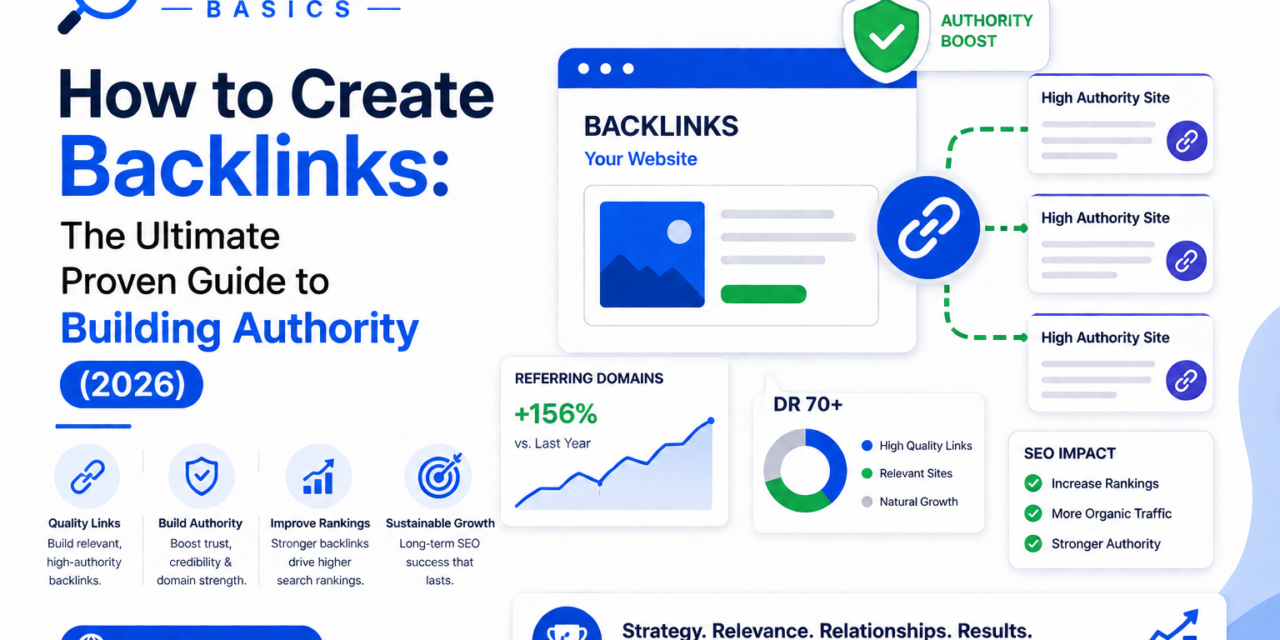
Result: “We saw a 156% increase in link acquisition when we pivoted from generic ‘how-to’ articles to publishing original research and proprietary data.” The report earned 47 referring domains in its first 90 days, including links from three industry publications with Domain Ratings above 70. Their Domain Rating climbed from 18 to 39 within one year.
Key takeaway: How to create backlinks at scale starts with creating something worth citing. Original data is the single most reliable trigger for earned links.
Case Study 2 — Relationship-First Outreach at 40% Conversion Rate
Background: A link-building specialist was hired by an e-commerce brand that had tried and failed with mass email outreach — sending 1,000 cold emails per month with a 1.2% response rate and almost no links earned.
Strategy: The specialist switched to a relationship-first approach: engaging with 50 high-quality prospects on social media, commenting thoughtfully on their content, and building genuine familiarity before pitching anything. Pitches were sent only after multiple genuine interactions.
Result: Marketers who sent 1,000 templated emails saw response rates hovering around 1–2%. Those who invested time in building genuine relationships with 50 high-quality prospects saw their success rates climb to 25–30%. The brand went from 3 links per month to 18 per month — with fewer emails sent.
Key takeaway: How to create backlinks more efficiently isn’t about more volume — it’s about more genuine relationships with fewer, higher-quality targets.
Case Study 3 — Broken Link Building Campaign
Background: An HR software company used Ahrefs to identify broken links on HR-related resource pages, career blogs, and business guides. They found 214 broken links pointing to dead pages about topics they had live content covering.
Strategy: They emailed the site owners of each broken link, pointed out the dead link, and suggested their article as a replacement. Emails were kept short, polite, and framed as a helpful heads-up rather than a link request.
Result: 31% of contacts responded positively and updated their links — generating 66 new DoFollow backlinks from relevant, high-authority domains in under 60 days. Cost: zero dollars. Time investment: approximately 8 hours of research and outreach.
Key takeaway: Broken link building is one of the fastest ways to understand how to create backlinks quickly — the pitch writes itself because you’re solving a problem the site owner already has.
Best Tools for Building Backlinks
| Tool | Best For | Price |
|---|---|---|
| Ahrefs | Backlink research, competitor analysis, broken link finding | From $129/month |
| Semrush | Backlink audits, link gap analysis, outreach tracking | From $139.95/month |
| Moz Link Explorer | Domain Authority checking, link opportunity research | From $99/month |
| BuzzStream | Managing outreach campaigns and relationship tracking | From $24/month |
| Hunter.io | Finding email addresses for outreach | Free / From $34/month |
| HARO (Help a Reporter Out) | Earning editorial links from journalists | Free |
| Pitchbox | Automated outreach at scale with personalization | From $165/month |
| Google Search Console | Monitoring your existing backlink profile | Free |
| Check My Links (Chrome) | Quickly finding broken links on any page | Free |
| BrandMentions | Finding unlinked brand mentions to convert | From $49/month |
For comprehensive coverage of backlink strategies and industry benchmarks, Search Engine Journal’s link building guide and Semrush’s backlink tactics resource are the most thoroughly researched and regularly updated public references available.
Common Mistakes When Creating Backlinks
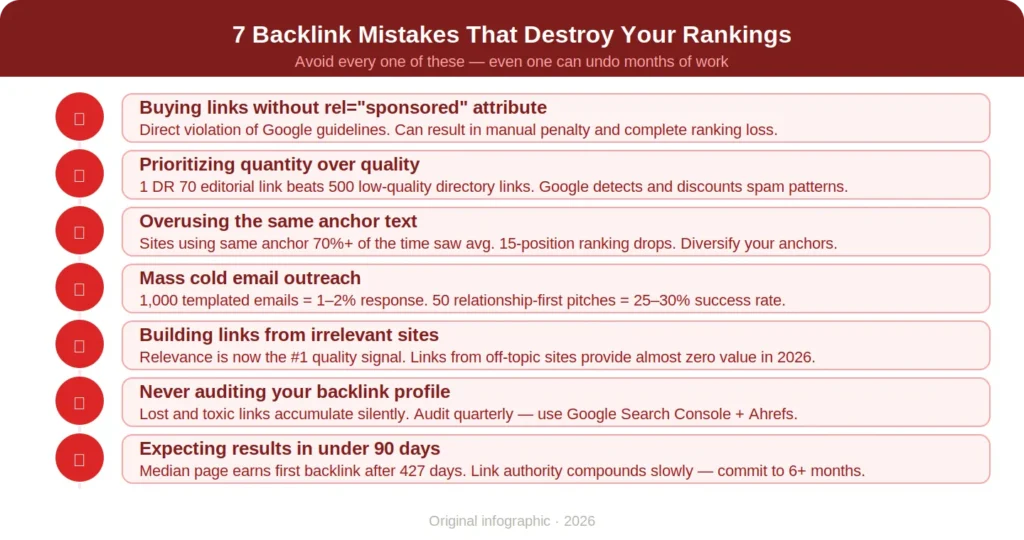
Understanding how to create backlinks also means understanding what not to do. These mistakes are the most common — and most damaging:
Mistake 1: Buying links without proper attributes Paying for links without using rel="sponsored" directly violates Google’s Webmaster Guidelines and can result in manual penalties. Bad backlinks kill your ranking, or worse. If you pay for placement, always mark it correctly.
Mistake 2: Prioritizing quantity over quality One editorial link from a DR 70 site is worth more than 500 links from low-quality directories. In 2026, search engines are far more advanced at detecting low-quality placements, spammy link patterns, and links created only for rankings.
Mistake 3: Using the same anchor text repeatedly Sites with anchor text diversity below 30% — meaning using the same anchor text more than 70% of the time — experienced an average ranking drop of 15 positions in competitive niches. Vary your anchor text: use branded, generic, and partial-match anchors across your link profile.
Mistake 4: Sending cold mass outreach Templated bulk emails deliver 1–2% response rates. Personalized relationship-first outreach to fewer, better-matched prospects delivers 25–40%. Volume is not the answer — relevance and personalization are.
Mistake 5: Ignoring relevance What makes a high-quality backlink in 2026 has shifted. The source and page must be tightly aligned with your topic. A link from an irrelevant site in a completely different industry provides minimal value and can look manipulative to Google’s algorithms.
Mistake 6: Building links and walking away Link profiles require ongoing maintenance. Links get removed, sites go offline, and competitors keep building. Schedule a quarterly backlink audit to identify lost links and maintain your profile’s health.
Mistake 7: Expecting instant results Expect 3+ months for noticeable results from link building. The median page earns its first backlink after 427 days of being published. SEO authority from backlinks compounds slowly but compoundingly — patience and consistency are the core requirements.
FAQs
Q: What is the fastest way to create backlinks? The fastest legitimate methods for how to create backlinks are converting unlinked brand mentions into linked ones (typically 25–40% conversion rate) and broken link building (where you replace dead links with your content). Both can produce results in days rather than months. Guest posting on sites that publish quickly is also among the faster routes to how to create backlinks effectively.
Q: How many backlinks do I need to rank on page 1? There’s no fixed number. It depends on your niche’s competitiveness and the quality of the links involved. Pages ranking first on Google have an average of 3.8 times more backlinks than positions 2–10, but a single high-authority editorial link can outweigh dozens of average ones. Focus on quality and relevance, not raw link count.
Q: Are NoFollow backlinks worth building? Yes — for two reasons. First, they drive real referral traffic regardless of SEO value. Second, a natural link profile includes both DoFollow and NoFollow links. A profile consisting entirely of DoFollow links can look manipulative and may trigger algorithmic scrutiny.
Q: Can I create backlinks for free? Yes. HARO journalist outreach, broken link building, unlinked mention reclamation, resource page outreach, and organic guest posting all cost time but no money. Free tools like Google Search Console, Check My Links, and Google Alerts support these strategies without any subscription.
Q: How do I know if a backlink is high quality? Evaluate it on four criteria: relevance (is the linking site about a related topic?), authority (does it have a high Domain Rating and real organic traffic?), placement (is the link in the main body content or buried in a footer/sidebar?), and context (does the surrounding text relate naturally to what you do?). Relevance, trust, context, and persistence are what define a high-quality backlink in 2026.
Q: How do backlinks affect AI visibility? 73.2% of marketers believe backlinks influence the chance of appearing in AI search results. When authoritative sites link to you and mention you alongside specific topics, AI systems like ChatGPT and Perplexity begin to recognize your brand as an authority in those areas — increasing your likelihood of being cited in AI-generated answers.
Q: Is guest posting still worth it in 2026? Yes, when done correctly. The key is treating guest posts as genuine editorial contributions to a relevant audience — not as vehicles for dropping links. High-quality guest posts on relevant, authoritative sites remain one of the most reliable methods for how to create backlinks that last.
Conclusion
How to create backlinks in 2026 is both simpler and harder than it used to be: simpler because the core principle hasn’t changed (earn links by being genuinely worth linking to), and harder because the quality bar has risen sharply and Google’s ability to detect manipulative link patterns has never been greater.
The businesses winning the backlink game today are those that invest in original research, build real relationships with journalists and publishers, create tools and resources so useful that links come naturally, and play a long game measured in months and years rather than days.
How to create backlinks isn’t a one-time project — it’s an ongoing commitment to building authority that compounds. The businesses that understand how to create backlinks sustainably today are the ones that will own the top rankings — and the AI citations — two years from now.
Related Reading: What Are SEO Keywords? The Proven Guide | What’s SEO? The Ultimate Beginner’s Guide
Actionable Takeaways
✅ This week: audit your existing backlink profile — open Google Search Console > Links > Top linking sites. Understand what you already have before building more.
✅ Convert unlinked mentions first — set up Google Alerts for your brand name today. Every time someone mentions you without a link is a quick-win backlink waiting to be claimed.
✅ Plan one linkable asset — choose your format (research report, free tool, statistics page, or ultimate guide) and commit to publishing it within 30 days. This is the single highest-leverage thing you can do for long-term link building.
✅ Register on HARO or Qwoted today — both are free. Respond to 3–5 journalist queries per day in your niche. Even one editorial mention from a major publication can transform your Domain Rating.
✅ Do competitor backlink research this week — enter your top competitor’s domain into Ahrefs or Semrush’s free trial. Export their top backlinks. Identify which sites link to them but not to you. That list is your outreach roadmap.
✅ Send 10 personalized broken link outreach emails — use Check My Links to find broken links on relevant resource pages. Replace them with your content. Expect a 25–35% success rate.
✅ Be patient and consistent — most backlink strategies take 3–6 months to show meaningful ranking improvements. Set a 90-day calendar reminder to review your Domain Rating progress. Authority compounds slowly — and then all at once.