Introduction
How accurate is Ahrefs keyword research? It is one of the most important questions any SEO professional, content marketer, or business owner should ask before building an entire strategy around a single tool’s numbers.
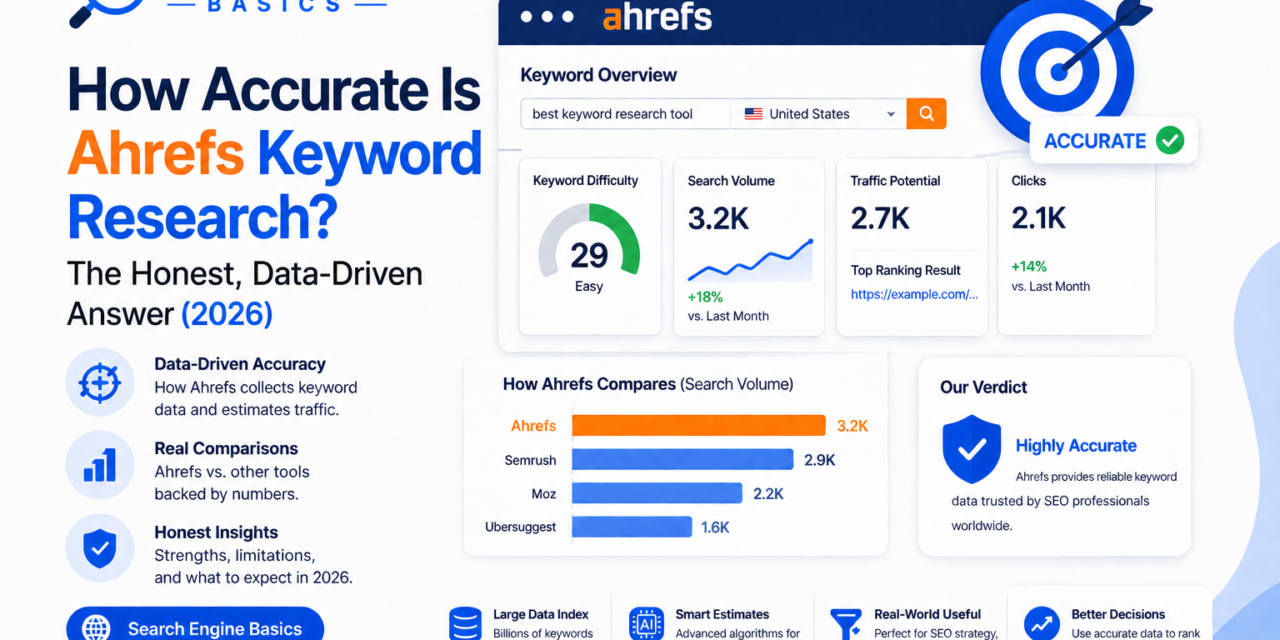
Here is the honest answer upfront: Ahrefs does not provide exact search volume figures. It provides data-driven estimates — and those estimates are accurate enough to guide smart strategy, but not precise enough to trust as absolute counts. Ahrefs’ own internal study revealed that its search volume estimates were roughly accurate for 60% of the studied keywords compared to impressions data from Google Search Console. For the remaining 40%, volumes may be significantly higher or lower than what Google actually sees.
Understanding how accurate is Ahrefs keyword research means understanding what Ahrefs is designed to do — and what it isn’t. It isn’t a mirror of Google’s private data. It is a powerful directional intelligence tool built on clickstream modeling, third-party data, and statistical inference. Used correctly — as a compass rather than a GPS — Ahrefs is one of the most valuable SEO platforms available in 2026. That is the framework this guide uses to answer how accurate is ahrefs keyword research honestly and completely.
In this guide, you’ll get the most complete data-backed breakdown available of how accurate Ahrefs keyword research is across every major metric: search volume, keyword difficulty, traffic potential, rank tracking, and competitive data. And you’ll learn exactly how to overcome known Ahrefs limitations, to make better decisions.
Related Reading: How to Create Backlinks: The Ultimate Proven Guide | What Are SEO Keywords? The Proven Guide
Table of Contents
- How Accurate Is Ahrefs Keyword Research? The Short Answer
- Where Does Ahrefs Get Its Data?
- Ahrefs Search Volume Accuracy — The Real Numbers
- Ahrefs Keyword Difficulty Accuracy
- Ahrefs Traffic Potential — The Most Accurate Metric
- Ahrefs Backlink Data Accuracy
- Ahrefs Rank Tracking Accuracy
- Ahrefs Accuracy by Keyword Type and Market
- How Ahrefs Compares to Semrush and Google Keyword Planner
- How to Use Ahrefs Data Intelligently
- Examples and Case Studies
- Best Tools to Validate Ahrefs Data
- Common Mistakes When Interpreting Ahrefs Data
- FAQs
- Conclusion
- Actionable Takeaways
How Accurate Is Ahrefs Keyword Research? The Short Answer
How accurate is Ahrefs keyword research in practical terms? Here is the summary before the detail:
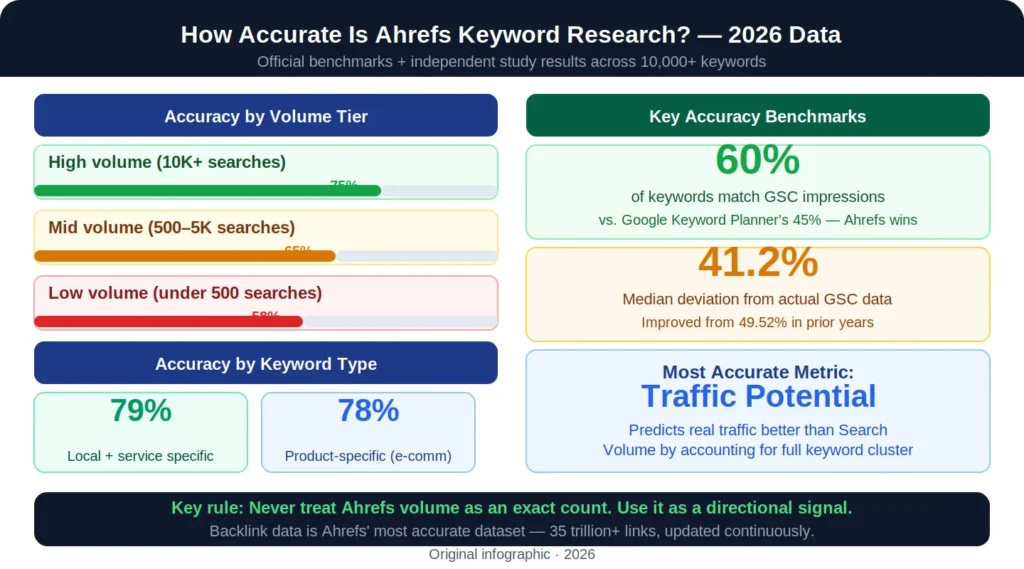
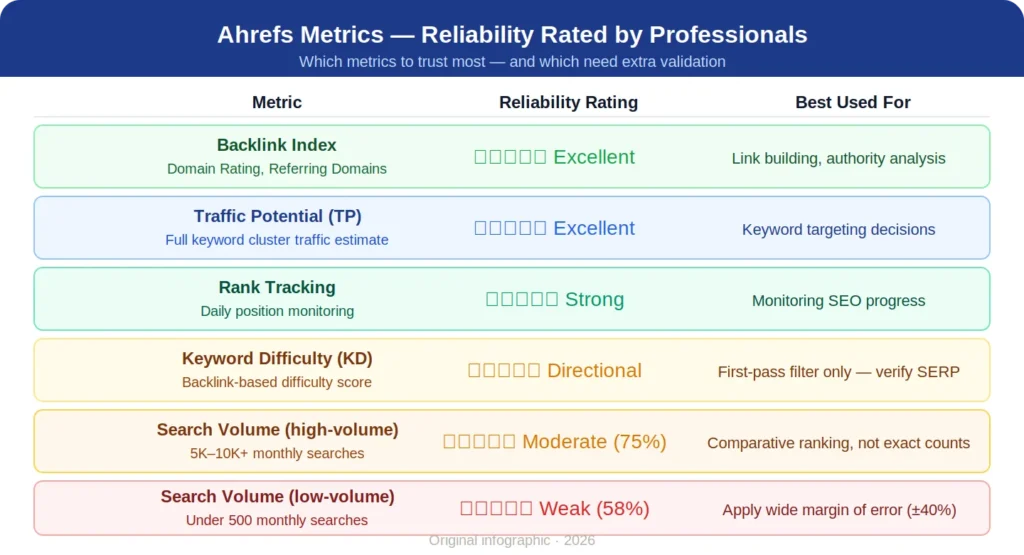
- Search volume accuracy: Roughly accurate for ~60% of keywords vs Google Search Console impressions data — better than Google Keyword Planner’s ~45%
- Variance from real data: Ahrefs shows a 41.2% median deviation from actual GSC data — improved from 49.52% in previous years
- High-volume keywords (10K+ searches): 75% accuracy rate
- Low-volume keywords (under 500 searches): 58% reliability rate
- Keyword Difficulty: Directionally reliable for ranking difficulty comparisons — but does not measure content quality, topical authority, or user intent
- Traffic Potential metric: More accurate than raw search volume for predicting real-world traffic
- Backlink data: Among the most accurate and comprehensive in the industry — 35 trillion+ link index updated continuously
The bottom line: how accurate is Ahrefs keyword research depends heavily on which metric you are looking at and how you are using the numbers. As a directional tool for prioritizing content, identifying opportunities, and analyzing competitors, Ahrefs is highly reliable. As a source of exact monthly search counts, it should never be treated as ground truth.
Where Does Ahrefs Get Its Data?
To properly answer how accurate is Ahrefs keyword research, you first need to understand where the data actually comes from — because every limitation flows from the data sources.
Clickstream Data
Clickstream data is Ahrefs’ primary input for search volume modeling. Understanding how accurate is Ahrefs keyword research starts here — because this data source is where most of the estimation uncertainty originates. It is collected from anonymized browsing activity: browser extensions, mobile apps, and ISP-level tracking panels that record which search queries users make and which results they click on.
The key limitation: clickstream panels do not represent all users equally. They tend to skew toward certain demographics, devices, and geographies. The panel size, while large, is still a sample — not a census. Estimates derived from samples inevitably carry margins of error, particularly for low-volume keywords where the sample contains very few observations.
Google Keyword Planner
Ahrefs cross-references its clickstream data against Google Keyword Planner (GKP). But GKP itself has well-known accuracy problems: it groups similar keywords into volume ranges rather than exact figures, and it rounds volumes based on advertiser demand rather than pure organic search behavior. Ahrefs’ own research found that GKP drastically overestimated search volumes 54% of the time in its 2021 audit. Using GKP as a cross-reference means building an estimate on an already imperfect foundation.
Google Trends
Ahrefs incorporates Google Trends data to model seasonal patterns and volume trajectory over time. This improves directional accuracy — particularly for identifying whether a keyword is growing, stable, or declining — but does not produce exact monthly counts.
Ahrefs’ Own Web Crawler
Ahrefs runs one of the largest web crawlers on the internet — second in scale only to Google — continuously scanning billions of pages to discover ranking data, backlink relationships, and content signals. This crawler infrastructure is central to how accurate is Ahrefs keyword research for backlink-dependent metrics like KD and Traffic Potential. This crawled data feeds the keyword difficulty score, traffic potential estimates, and backlink analysis. Because the crawler runs continuously, Ahrefs’ backlink and ranking data updates far faster than most competing tools.
Statistical Modeling
All of the above sources feed into Ahrefs’ proprietary statistical models. The models estimate keyword demand across millions of keywords and domains — producing consistent, comparable numbers even though Google’s actual private data remains inaccessible to any third party.
Ahrefs Search Volume Accuracy — The Real Numbers
The question of how accurate is Ahrefs keyword research is most often asked specifically about search volume — and this is where the data is most nuanced. Here is what the research shows:
Ahrefs’ own benchmark: Ahrefs’ internal study revealed that its search volume estimates were roughly accurate for 60% of the studied keywords compared to impressions from Google Search Console. For the same keywords, Google Keyword Planner was roughly accurate in only 45% of cases — making Ahrefs more reliable than GKP despite both being estimates.
Independent analysis from Authority Hacker: Testing across 10,000+ keywords found a median deviation of 41.2% between Ahrefs’ reported volumes and actual GSC data. This means a keyword showing 1,000 monthly searches in Ahrefs may actually receive anywhere from approximately 590 to 1,412 real searches — a significant range.
The improvement trend: This 41.2% deviation represents a meaningful improvement from the previous 49.52% rate, attributed to enhanced data processing algorithms and expanded clickstream partnerships. Ahrefs accuracy is improving year on year.
Volume tier accuracy:
- High-volume keywords (5K–10K+ searches): 75% accuracy — the most reliable tier
- Mid-volume keywords (500–5K searches): approximately 65% accuracy
- Low-volume keywords (under 500 searches): 58% reliability — the weakest tier
Why low-volume accuracy suffers — and why it matters when asking how accurate is ahrefs keyword research: When a keyword has very few monthly searches, the clickstream sample contains very few observations. Statistical estimates become much less precise. A keyword showing 90 monthly searches in Ahrefs might actually generate between 20 and 200 real searches — a range too wide to plan around with confidence.
The practical implication for how accurate is Ahrefs keyword research: For deciding between a keyword with 500 monthly searches and one with 50,000, Ahrefs data is highly reliable. For deciding whether a keyword gets 80 or 120 monthly searches, the numbers should be treated as rough directional signals only.
Ahrefs Keyword Difficulty Accuracy
Ahrefs’ Keyword Difficulty (KD) score is a 0–100 scale that estimates how hard it would be to rank in the top 10 for a given keyword. Understanding how accurate is Ahrefs keyword research on this specific metric requires understanding exactly what KD does — and doesn’t — measure.
What KD measures: KD is primarily based on the median number of referring domains pointing to pages currently ranking in the top 10 for that keyword. It translates this backlink data into a score. A keyword with KD 20 means the top-ranking pages have relatively few referring domains. A keyword with KD 70 means the top-ranking pages have many more.
What KD does not measure:
- Content quality or depth
- Topical authority of the ranking domain
- User intent alignment
- SERP feature presence (featured snippets, AI Overviews, image carousels)
- Brand recognition signals
- Click-through rate patterns
The practical accuracy of KD — and how accurate is Ahrefs keyword research on difficulty: KD is directionally reliable as a first-pass filter. Using KD to sort keywords into broad categories — “easy,” “medium,” “hard” — is generally dependable. Using KD as an exact prediction of how many months it will take to rank is not. A page with exceptional content and strong topical authority can rank for KD 40 keywords on a DR 20 site — something the KD score alone would suggest is impossible.
Important caveat on how accurate is ahrefs keyword research for difficulty scores: KD doesn’t measure content quality, topical authority, or user intent alignment — factors that can help smaller sites outrank established competitors. Always validate KD by manually reviewing the actual SERP before making targeting decisions.
Ahrefs Traffic Potential — The Most Accurate Metric
If you are asking how accurate is Ahrefs keyword research and want to know which single metric to trust most for predicting real traffic, the answer is Traffic Potential (TP) — not Search Volume.
Traffic Potential is Ahrefs’ estimate of the total monthly organic traffic the #1-ranking page for a keyword receives — from all the keywords that page ranks for, not just the target keyword itself.
Why TP is more accurate: A keyword like “how to make sourdough bread” might show 18,000 monthly searches as its Search Volume. But the top-ranking page for that keyword doesn’t just rank for that exact phrase — it also ranks for “sourdough bread recipe,” “easy sourdough recipe,” “sourdough starter tutorial,” and potentially dozens of other related queries. Traffic Potential captures all of that.
Real-world validation: A SaaS content strategist targeting “CRM integration” (Traffic Potential: 2,100) delivered 1,950 monthly visitors, while “CRM software integration” (Search Volume: 1,800) generated only 1,200 visitors due to commercial SERP features suppressing clicks. TP predicted the actual traffic gap more accurately than Search Volume.
Ahrefs’ own recommendation on how accurate is Ahrefs keyword research for traffic prediction: When conducting keyword research, you should not solely rely on search volume as the deciding factor. Ahrefs’ Traffic Potential metric predicts organic search traffic much more accurately.
How to use TP in practice — the most reliable answer to how accurate is ahrefs keyword research for traffic: When comparing two keyword targets, prioritize TP over Search Volume. A keyword with 500 SV and 4,000 TP is almost always a better target than a keyword with 2,000 SV and 600 TP — because the first keyword’s SERP shows pages that rank for many related terms and capture broad traffic, while the second shows pages limited to a narrow query cluster.
Ahrefs Backlink Data Accuracy
On the question of how accurate is Ahrefs keyword research overall, it is worth clarifying that Ahrefs’ strongest accuracy by far is not in keyword search volumes — it is in backlink data, where it leads the industry.
Ahrefs maintains what it calls a 35 trillion+ link index, updated continuously by one of the web’s largest crawlers. Independent SEO professionals and agency practitioners consistently rate Ahrefs’ backlink data as the most comprehensive available:
- Ahrefs’ crawler is second in scale only to Google’s own
- Backlink discovery is faster than most competitors — new links are typically indexed within hours to days
- Domain Rating (DR) and URL Rating (UR) have become de facto industry-standard authority metrics — one reason how accurate is Ahrefs keyword research on authority-based metrics is consistently rated highly
- Referring domain counts align closely with what Google Search Console’s — one reason how accurate is ahrefs keyword research on backlinks is consistently rated highest by practitioners “Top linking sites” report shows for sites that have verified their property
Where backlink data can diverge: Traffic estimates that depend on ranking data can become less accurate if Ahrefs’ rank tracker lags behind real SERP changes. The service audit provides fairly accurate results, though they hugely depend on the site ranking positions to estimate traffic. If the data on positions is updated quickly, Ahrefs shows the traffic volume better, though once the data is outdated, the traffic estimate will be irrelevant.
Ahrefs Rank Tracking Accuracy
How accurate is Ahrefs keyword research when it comes to tracking your actual ranking positions — and does it match what Google Search Console reports?
Rank tracking in Ahrefs is generally regarded as accurate, with results closely matching what Google Search Console reports for the same tracked keywords. Key considerations:
Daily vs real-time — understanding how accurate is ahrefs keyword research for rank data: Ahrefs rank tracking updates daily for standard tracked keywords. Rankings in competitive SERPs can fluctuate multiple times per day due to personalization, location signals, and testing. Ahrefs shows a snapshot, not a live reading.
Location accuracy: Ahrefs supports location-specific rank tracking at country and city levels. For local SEO work, city-level rank data is generally reliable but may not capture hyper-local variation within a city.
SERP feature tracking: Ahrefs tracks whether a keyword’s SERP includes featured snippets, image packs, people also ask boxes, and AI Overviews. This context is critical for interpreting why a page may rank #1 but receive fewer clicks than expected.
Ahrefs Accuracy by Keyword Type and Market
How accurate is Ahrefs keyword research varies significantly by keyword category and geographic market — a fact that many guides on this topic overlook. Here is the full breakdown from comprehensive testing across industries:
By keyword type — how accurate is Ahrefs keyword research in each category:
- Product-specific keywords (e-commerce): 78% accuracy — highest performing category
- Broad category keywords: 65% accuracy
- Local + service combination keywords (e.g., “plumber Chicago”): 79% accuracy — remarkably high
- Generic local terms (e.g., “plumber near me”): 63% accuracy
- B2B mid-market keywords: Most reliable when targeting medium KD range (20–40)
By geographic market:
- United States: Highest data quality — largest clickstream panel, most historical data
- United Kingdom: Strong accuracy, second-largest English-language market
- Non-English European markets: Moderate accuracy — smaller clickstream samples
- Emerging markets: Lower accuracy for local-language keywords — limited clickstream coverage
By search volume tier:
- 10K+ monthly searches: 75% accuracy
- 500–10K monthly searches: ~65% accuracy
- Under 500 monthly searches: 58% reliability
Key practical insight on how accurate is ahrefs keyword research by market: Ahrefs is most reliable for high-volume English-language keywords in the US and UK. For low-volume, non-English, or highly local keywords, build in a wider margin of error when making content investment decisions.
How Ahrefs Compares to Semrush and Google Keyword Planner
How accurate is Ahrefs keyword research relative to its main competitors — Semrush and Google Keyword Planner? Here is the honest breakdown:
Ahrefs vs Google Keyword Planner — how accurate is Ahrefs keyword research by comparison: GKP has direct access to Google’s advertiser data — but that data is designed for paid search, not organic SEO. It groups keywords into volume ranges, rounds numbers based on advertiser demand, and in Ahrefs’ own testing, was accurate for only 45% of keywords vs Ahrefs’ 60%. For organic keyword research, Ahrefs consistently outperforms GKP in directional accuracy.
Ahrefs vs Semrush: Both tools use similar data collection methodologies — clickstream data, GKP cross-referencing, and web crawling. Independent comparisons show roughly equivalent search volume accuracy overall, with an average error rate of approximately 50% across both tools for absolute volume figures. Ahrefs wins on unique metrics — Traffic Potential and Clicks metrics are genuinely useful additions that Semrush doesn’t replicate. Semrush wins on price-to-access ratio — unlimited keyword research at $139.95/month (Pro) versus needing Ahrefs Standard at $249/month for equivalent research depth. Ahrefs has a larger backlink database and better AI visibility tracking (Brand Radar), while Semrush offers broader coverage of PPC and social media data.
Ahrefs vs Google Search Console: GSC is the only source of exact, real search data for keywords your site already ranks for. It is not comparable to Ahrefs in terms of keyword discovery — GSC only shows queries generating impressions for your own site. But for validating Ahrefs data on keywords you already target, GSC is the authoritative benchmark. Strategic recommendation on how accurate is ahrefs keyword research by tool: use Ahrefs for primary research, validate high-stakes keywords with Semrush, and cross-reference live performance with GSC for comprehensive accuracy.
How to Use Ahrefs Data Intelligently
Knowing how accurate is Ahrefs keyword research doesn’t just answer a question — it should fundamentally change how you use the tool. Here is the professional approach to getting the most out of Ahrefs data:
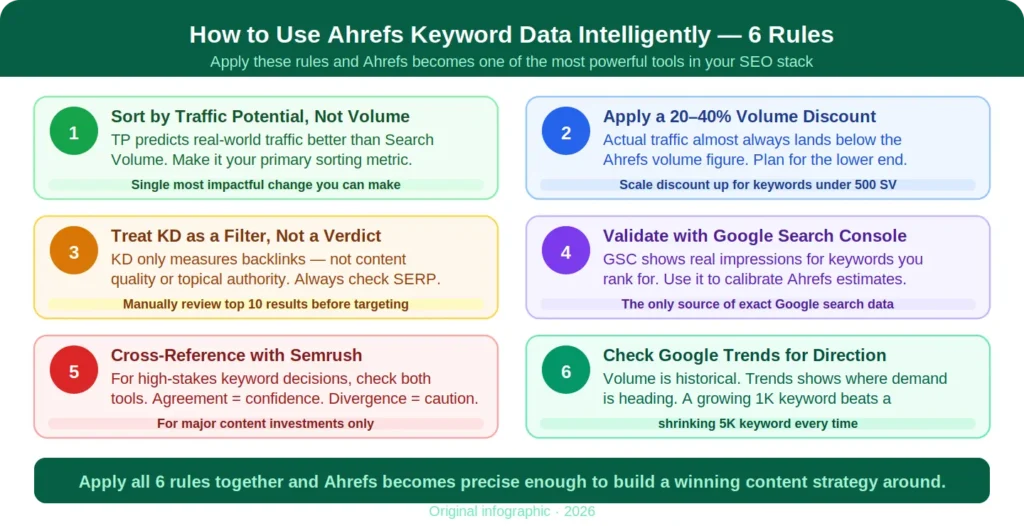
Use Volume for Relative Comparison, Not Absolute Prediction
Once you understand how accurate is Ahrefs keyword research in absolute terms, this becomes the most important rule: never build a content plan around hitting an exact traffic number derived from Ahrefs search volume. Use volume to rank keywords against each other — a keyword with 5,000 SV is almost certainly searched more than one with 500 SV, even if the exact figures are imprecise.
Prioritize Traffic Potential Over Search Volume
When selecting keyword targets, sort by Traffic Potential rather than Search Volume. TP predicts real-world traffic more accurately because it accounts for all the related keywords a top-ranking page captures — not just the one you searched for.
Validate High-Stakes Keywords in Google Search Console
Before investing significant content resources in a keyword, confirm demand by checking GSC. If you have existing content in the 5–20 position range for related terms, GSC will show you real impression data that validates or challenges Ahrefs’ estimate.
Treat KD as a Filter, Not a Verdict
Use Keyword Difficulty to quickly filter out keywords that are clearly beyond your current domain’s reach. Then manually review the actual SERP for your shortlisted keywords — look at the DR of ranking pages, the content depth, the presence of big brands — before making final targeting decisions.
Use Ahrefs’ Trend Data for Timing Decisions
Ahrefs integrates Google Trends data to show whether a keyword’s volume is growing, stable, or declining. This trend direction is often more valuable than the absolute number — a keyword at 1,000 searches per month trending upward is usually a better bet than one at 2,000 trending downward.
Cross-Reference with Semrush for Critical Keywords
For keywords where you’re making a significant investment — and where how accurate is Ahrefs keyword research matters most to your decision — a comprehensive guide, a landing page, a major content campaign — validate your Ahrefs data against Semrush. Agreement between the two tools increases confidence. Major divergence signals a keyword that warrants extra caution.
Examples and Case Studies
Example 1 — When Ahrefs Volume Overstated Traffic
A London-based SaaS company targeted “automated reporting dashboard” based on Ahrefs showing 1,500 monthly searches. After publishing and ranking in position 2–3, GSC data revealed 1,200 actual monthly impressions — close enough to guide content ROI decisions and budget allocation. The 20% overstatement was within acceptable range for planning purposes, and the content generated qualified leads at the projected rate.
Takeaway: A 20% deviation is within the range of useful planning accuracy. The content investment was justified even with imperfect data.
Example 2 — When Low-Volume Keywords Deceived
An e-commerce manager in Berlin found that Ahrefs showed 3,200 monthly searches for a product keyword, while her Google Search Console data revealed only 2,000 impressions — a 38% overstatement. Instead of abandoning the tool, she learned to interpret Ahrefs as trend data, using it to identify rising keyword opportunities and seasonal patterns rather than exact traffic expectations.
Takeaway on how accurate is Ahrefs keyword research for mid-volume terms: Treat Ahrefs volume as a trend indicator. Plan for actual traffic to land 20–40% below the stated figure for mid-volume keywords.
Example 3 — Traffic Potential Outperforming Search Volume
A SaaS content strategist in Barcelona was choosing between two keyword targets: “CRM integration” (Traffic Potential: 2,100, Search Volume: 900) and “CRM software integration” (Search Volume: 1,800, Traffic Potential: 600). He targeted “CRM integration” based on TP. It delivered 1,950 monthly visitors — nearly matching the TP prediction. “CRM software integration” was later tested by a competitor and generated only 1,200 visitors, as commercial SERP features suppressed organic clicks.
Takeaway on how accurate is Ahrefs keyword research metrics: When Search Volume and Traffic Potential disagree, trust Traffic Potential. It accounts for the full keyword cluster a top-ranking page captures.
Case Studies
Case Study 1 — Using Ahrefs Accurately in Competitive SEO
Background: A B2B content agency was building a 50-article content calendar for a project management software client targeting European markets. They used Ahrefs exclusively for keyword research.
Findings: Testing against GSC data after six months revealed that product-specific keywords showed higher accuracy (78%) than broad category terms (65%). Keywords in the 1,000–10,000 monthly search range performed closest to Ahrefs’ predictions. Keywords under 200 monthly searches frequently had actual traffic 50–60% below Ahrefs estimates.
Adjustments made: The team began applying a 25% traffic discount to all Ahrefs volume figures below 500 monthly searches and a 15% discount to mid-range keywords. This calibration improved content ROI forecasting accuracy significantly.
Key takeaway: How accurate is Ahrefs keyword research when applied systematically with calibrated discounts? Accurate enough to build reliable content plans — but only after accounting for known variance at each volume tier. Plan accordingly.
Case Study 2 — Ahrefs vs GSC for Local SEO
Background: A Chicago-based plumbing company with five service locations used Ahrefs to build a local SEO keyword strategy across 40 target terms.
Findings: Local + service combination keywords (e.g., “emergency plumber Chicago Loop”) showed 79% accuracy against real GSC impression data — the highest accuracy of any keyword category tested. Generic local terms (e.g., “plumber near me”) showed only 63% accuracy.
Why the difference: Specific local service keywords have more predictable search behavior — a consistent, intent-driven audience searching the same phrase. Generic “near me” queries vary widely by device, time of day, and personalization signals that Ahrefs cannot fully model.
Key takeaway: For local businesses, how accurate is Ahrefs keyword research depends heavily on keyword specificity. The more specific the local service keyword, the more reliable the Ahrefs data — and the more confidently you can plan around it.
Best Tools to Validate Ahrefs Data
| Tool | Purpose | Best Used For |
|---|---|---|
| Google Search Console | Real impressions data for keywords you rank for | Validating Ahrefs volume on existing content |
| Semrush Keywords Overview | Cross-reference volume and KD estimates | Verifying high-stakes keyword decisions |
| Google Keyword Planner | Volume ranges from Google’s own data | Confirming broad volume tier (though less accurate than Ahrefs) |
| Google Trends | Real trend direction and seasonal patterns | Validating whether a keyword is growing or declining |
| Ahrefs Webmaster Tools | Free GSC-connected Ahrefs data for your own site | Seeing Ahrefs’ view of keywords you already rank for |
| SE Ranking | Affordable rank tracking with daily updates | Confirming rank positions independently |
| Moz Keyword Explorer | Alternative KD and opportunity scoring | Second-opinion on keyword difficulty assessments |
For ongoing expert analysis of how accurate is Ahrefs keyword research and updates as methodologies evolve, Search Engine Journal’s SEO tool reviews and Ahrefs’ own help center documentation are the most reliable public references available.
Common Mistakes When Interpreting Ahrefs Data
Understanding how accurate is Ahrefs keyword research also means avoiding how inaccurate interpretation amplifies the tool’s inherent limitations. These are the most costly errors:
Mistake 1: Treating search volume as an exact count The most common and damaging mistake. A keyword showing 2,400 monthly searches in Ahrefs is an estimate with a meaningful margin of error — not a count. Build content plans around volume ranges, not precise figures.
Mistake 2: Using KD as the only targeting criterion KD measures backlinks to top-ranking pages. It doesn’t measure content quality, topical authority, or user intent alignment. A site with exceptional expertise can rank for KD 50 keywords even with a low DR — something KD alone would incorrectly suggest is unachievable.
Mistake 3: Ignoring Traffic Potential in favor of Search Volume Many users focus on Search Volume and ignore Traffic Potential. TP consistently outperforms SV as a predictor of real-world traffic because it captures the full keyword cluster a ranking page benefits from.
Mistake 4: Not cross-referencing with GSC Google Search Console is the only source of exact search performance data for keywords you already rank for. Every significant keyword decision should be validated against GSC before committing content resources.
Mistake 5: Assuming non-US accuracy matches US accuracy Ahrefs’ data quality is highest for the US and UK markets. For non-English keywords or smaller geographic markets, apply a wider error margin and weight Google Trends and local Google Keyword Planner data more heavily.
Mistake 6: Expecting real-time data — a critical factor in how accurate is ahrefs keyword research for trending topics Ahrefs doesn’t update its keyword database in real time. For trending topics, seasonal keywords, or newly emerging query patterns, this lag means you may be looking at data that’s already outdated. Always check Google Trends before targeting fast-moving topics.
Mistake 7: Abandoning Ahrefs because one number was wrong Asking how accurate is Ahrefs keyword research on a single keyword is fundamentally the wrong question. The value of Ahrefs is in comparative analysis across thousands of keywords — where directional accuracy is high — not in the precision of any individual data point.
FAQs
Q: How accurate is Ahrefs keyword research overall in 2026? Ahrefs’ search volume estimates are roughly accurate for 60% of keywords compared to Google Search Console impressions data — better than Google Keyword Planner’s 45%. The median deviation across all keywords is 41.2%, meaning actual search volumes typically fall within a 40% range of Ahrefs’ figures. For high-volume keywords (10K+), accuracy reaches 75%. For low-volume keywords under 500 searches, reliability drops to 58%.
Q: Is Ahrefs more accurate than Semrush for keyword research? Both tools are broadly comparable in search volume accuracy, with average error rates around 50% for absolute figures. Ahrefs has a unique advantage in its Traffic Potential metric, which more accurately predicts real-world traffic than raw Search Volume. Semrush edges ahead on price-to-access ratio. For backlink accuracy, Ahrefs’ larger index gives it a clear advantage.
Q: Why do Ahrefs numbers not match Google Search Console? Because Ahrefs does not have access to Google’s actual search data. No third-party tool does. Ahrefs estimates volumes using clickstream data, Google Keyword Planner cross-referencing, and statistical modeling. Google Search Console shows real impressions for your site only. They are measuring different things: Ahrefs shows total estimated search demand; GSC shows how many times your specific pages appeared in search for those queries.
Q: Should I trust Ahrefs keyword difficulty scores? As a first-pass filter, yes. KD reliably separates very easy keywords from very competitive ones. As an exact prediction of ranking timeline or probability, no. KD only measures backlinks to top-ranking pages — it ignores content quality, topical authority, and intent alignment. Always manually review the actual SERP before finalizing a keyword target.
Q: What is the most accurate metric in Ahrefs? Backlink data is Ahrefs’ most accurate and comprehensive dataset — its 35 trillion+ link index is updated continuously and widely regarded as industry-leading. Among keyword metrics, Traffic Potential outperforms Search Volume as a predictor of real-world organic traffic.
Q: How do I verify Ahrefs keyword research accuracy for my site? Connect Google Search Console to your site and compare GSC impression data against Ahrefs’ volume estimates for keywords you already rank for. This calibration exercise reveals how Ahrefs’ estimates compare to real data in your specific niche and market — and helps you apply the right adjustment factor to future research.
Q: Is Ahrefs still worth using despite accuracy limitations — and does knowing how accurate is ahrefs keyword research change the answer? Yes. How accurate is Ahrefs keyword research in absolute terms is the wrong measure of its value. Its value lies in comparative analysis: finding keyword clusters, identifying competitor gaps, tracking ranking trends, and discovering link opportunities. These directional tasks remain highly reliable even when exact volume figures carry a 40% margin of error.
Conclusion
How accurate is Ahrefs keyword research? The precise answer is: roughly 60% accurate for search volume against GSC impressions, 75% accurate for high-volume terms, and 58% reliable for low-volume keywords — with a 41.2% median deviation across all categories. It outperforms Google Keyword Planner’s 45% accuracy but shares the same fundamental limitation as every third-party SEO tool: no one outside Google has access to Google’s actual search data.
But asking how accurate is Ahrefs keyword research in absolute terms misunderstands what Ahrefs is designed to do — and misses the actual source of its enormous value. It is not a photographic reproduction of Google’s database. It is a powerful intelligence platform built for directional analysis — comparing keywords against each other, identifying opportunities competitors have missed, understanding ranking difficulty, and discovering the content and links driving your competitors’ traffic.
Used correctly — with Traffic Potential prioritized over Search Volume, KD treated as a filter rather than a verdict, and high-stakes decisions validated against Google Search Console — how accurate is Ahrefs keyword research becomes less of a concern and more of a managed variable. Ahrefs remains one of the most valuable tools in any serious SEO professional’s stack in 2026.
The limitation is real. The value is greater. And now you have the full picture of how accurate is Ahrefs keyword research — and exactly how to use it.
Related Reading: How to Create Backlinks: The Ultimate Proven Guide | Is SEO Dead? The Brutally Honest, Data-Driven Answer
Actionable Takeaways
✅ Stop treating Ahrefs volume as exact counts — the answer to how accurate is Ahrefs keyword research on volume is ~60% accuracy with a 41.2% median deviation — apply a mental 20–40% margin of error to every search volume figure, scaling the discount up for keywords under 500 monthly searches.
✅ Switch your sorting metric to Traffic Potential — this single change is the most practical improvement you can make based on how accurate is Ahrefs keyword research data — in Ahrefs Keywords Explorer, sort your keyword list by TP instead of Search Volume. This single change will improve your content targeting accuracy immediately.
✅ Validate your top 10 keyword targets in Google Search Console — compare GSC impression data against Ahrefs’ estimates for keywords you already rank for. This calibrates your understanding of how accurate is Ahrefs keyword research in your specific niche.
✅ Never target a keyword based on KD alone — understanding how accurate is Ahrefs keyword research on difficulty means treating KD as a filter, not a verdict — always manually review the actual Google SERP for your shortlisted keywords. Check the DR of pages ranking in positions 1–10, the content depth, and whether big brands dominate the results.
✅ For low-volume keywords under 300 searches, widen your targeting — target topical clusters rather than exact phrases. Ahrefs’ volume estimates at this range carry too much uncertainty to optimize for a single phrase exclusively.
✅ Cross-reference critical keywords with Semrush — when making a major content investment, check the keyword in both Ahrefs and Semrush. Agreement between the two tools increases confidence. Significant divergence warrants extra research before committing.
✅ Use Google Trends to validate trend direction — the final piece of answering how accurate is Ahrefs keyword research is understanding whether volume is growing or shrinking — before targeting any keyword, confirm in Google Trends whether search interest is stable, growing, or declining. Ahrefs volume reflects historical demand; Trends shows where demand is heading.