Introduction
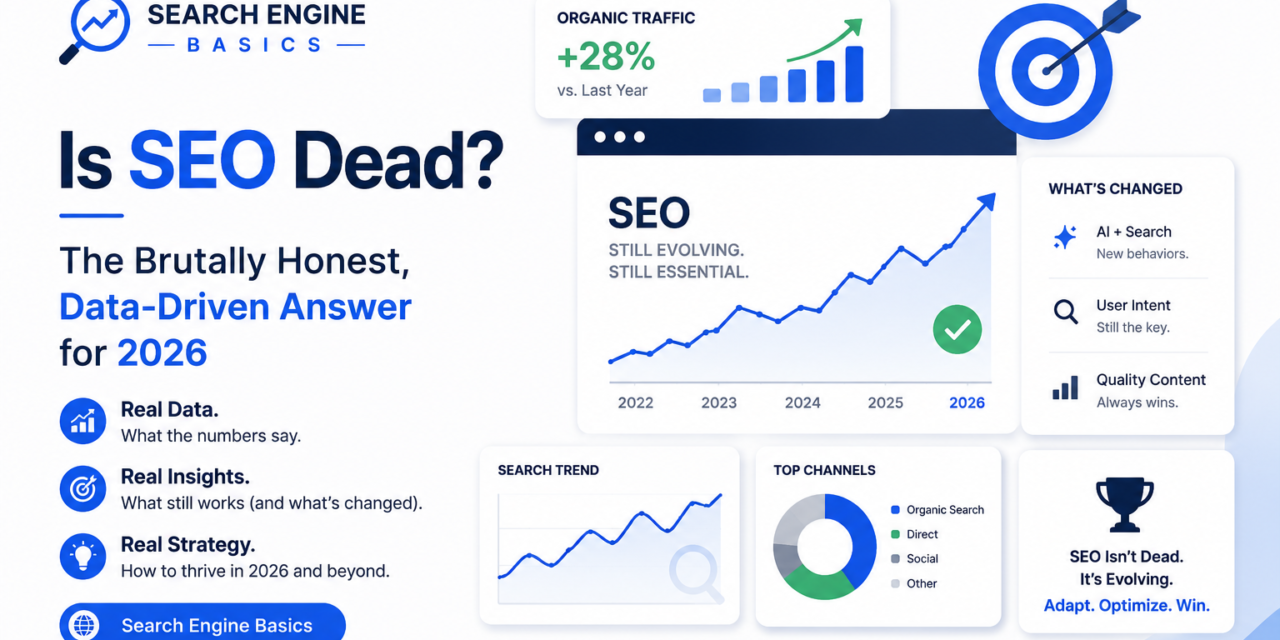
Is SEO dead? It’s the question every marketer, blogger, and business owner is asking in 2026 — and understandably so. AI Overviews now dominate the top of Google’s search results. Zero-click searches have crossed 60%. ChatGPT is fielding 900 million weekly active users. Organic traffic to major publishers is down sharply. The panic is real, and the headlines are dramatic.
But is SEO dead — really? The answer, backed by data rather than fear, is no. SEO is not dead. What is dead is the version of SEO built on publishing thin content, targeting easy keywords, and counting blue-link clicks as the primary measure of success. That playbook is finished. What has replaced it is something more demanding, more sophisticated, and — for those who adapt — more valuable than ever.
Is SEO dead for those who refuse to change? For them, it might as well be. Is SEO dead for businesses that understand what search has become in 2026 and optimize accordingly? Not remotely.
In this guide, you’ll get a data-driven answer to the question “is SEO dead” — along with an honest assessment of what has changed, what still works, and exactly what you need to do differently to stay visible in an AI-powered search landscape.
Related Reading: What’s SEO? The Ultimate Beginner’s Guide | What Are SEO Keywords? The Proven Guide
Table of Contents
- Is SEO Dead? The Short Answer
- Why People Think SEO Is Dead
- The Data That Proves SEO Is Not Dead
- What Has Actually Changed in SEO
- What’s Working in SEO Right Now
- How to Adapt Your SEO Strategy for 2026
- Examples of SEO Working in 2026
- Case Studies
- Best Tools for Modern SEO in 2026
- Common Mistakes That Make SEO Feel Dead
- FAQs
- Conclusion
- Actionable Takeaways
Is SEO Dead? The Short Answer
Is SEO dead? No — but traditional SEO as most people practiced it is no longer sufficient on its own.
Here is what the data actually shows as of mid-2026:
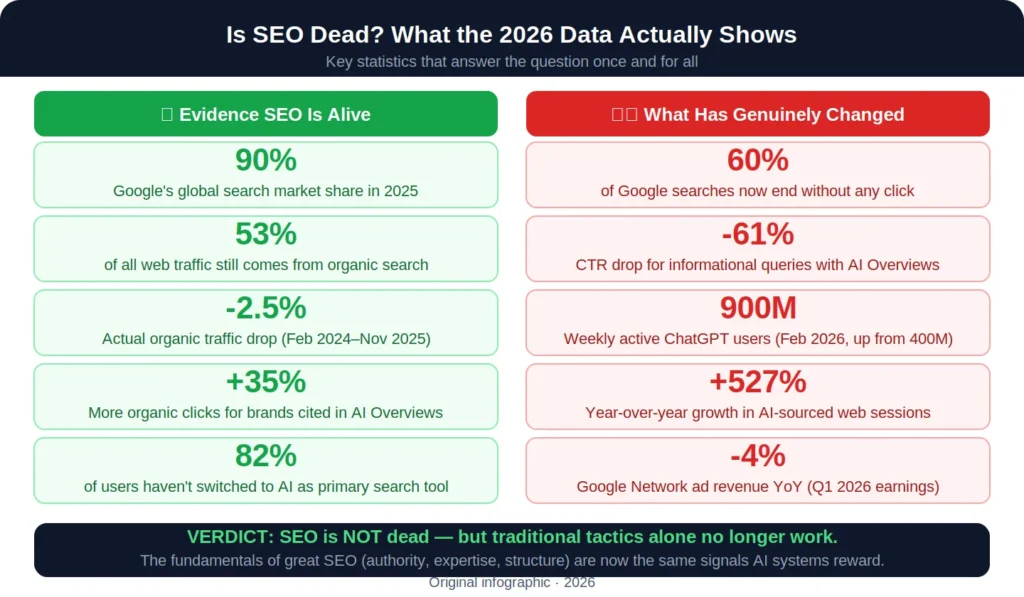
- Google still controls 89–90% of global search traffic — processing over 5 trillion searches per year, up from 2 trillion in 2016
- Organic search still drives 53% of all trackable website traffic — more than paid, social, email, and direct combined
- Organic search traffic declined by only 2.5% between February 2024 and November 2025 — not the 25–50% collapse many predicted
- 82% of search users haven’t used generative AI as their primary search tool regularly
- Brands cited in Google AI Overviews earn 35% more organic clicks and 91% more paid clicks than non-cited brands on the same page
Is SEO dead? The businesses abandoning SEO right now are leaving an enormous amount of organic traffic on the table for their competitors to capture. The smart money isn’t exiting SEO — it’s evolving it.
Why People Think SEO Is Dead
To answer “is SEO dead” honestly, we need to acknowledge why so many people are asking the question in the first place. The concerns are legitimate, even if the conclusion is wrong.
Zero-click searches are rising sharply. Nearly 60% of Google searches in 2026 end without a click to any external website, according to SparkToro. Google’s AI Overviews, featured snippets, Knowledge Panels, and instant answer boxes now resolve many queries — especially simple informational ones — before users ever reach the organic results. For content that answers basic factual questions, clicks have dropped significantly.
AI Overviews are suppressing CTR on informational queries. Research from Seer Interactive tracking 3,119 informational search terms across 42 organizations found that organic CTR dropped 61% for queries where AI Overviews appear — falling from 1.76% to 0.61% over 15 months to September 2025. That is a real and material decline.
AI-powered search tools are growing explosively. ChatGPT reached 900 million weekly active users by February 2026, up from 400 million a year earlier. AI-sourced website sessions grew 527% year-over-year comparing early 2024 to early 2025. These are not small numbers — AI is becoming a genuine search surface that marketers must understand.
Major publishers are reporting significant traffic losses. HubSpot estimates a 70–80% organic traffic decline. Business Insider lost 55% of organic traffic from April 2022 to April 2025. Chegg’s revenue fell 24% year-over-year and the company sued Google in February 2025, explicitly citing AI Overview impact. These are alarming real-world data points.
Google’s network ad revenue fell 4% in Q1 2026, while Google’s own search revenue grew 19% — a clear signal that AI is compressing the open web economy while concentrating value within Google itself.
These are all real trends. Is SEO dead because of them? No — but they represent a genuine structural shift that demands a genuine strategic response.
The Data That Proves SEO Is Not Dead
Is SEO dead when the numbers are examined in full? Absolutely not. Here is the counter-evidence that most “SEO is dead” articles overlook:
Google’s search volume is still growing. Google processes over 5 trillion searches per year in 2026 — up from 2 trillion in 2016. A declining share of a rapidly growing market still represents enormous absolute volume. The pie that SEO competes for is larger than it has ever been.
Organic traffic is down only 2.5%, not 50%. Graphite’s January 2026 analysis found that organic search traffic declined by just 2.5% between February 2024 and November 2025. The dramatic collapse predicted by some has not materialized. The channel is under pressure, not in freefall.
57% of users still prefer traditional search for important topics. An NN Group February 2026 survey revealed that people use AI to explore and synthesize information, but rely on traditional search to double-check factual accuracy. For high-stakes decisions — health, finance, legal, major purchases — users are not yet trusting AI alone.
AI referral traffic is growing at 527% year-over-year. AI-sourced sessions are growing explosively — and the businesses appearing in AI citations are benefiting directly. AI-referred visitors browse 12% more pages per visit and show a 23% lower bounce rate than non-AI referrals, according to Adobe research.
Being cited in AI Overviews is extraordinarily valuable. Brands cited in Google AI Overviews see 35% more organic clicks and 91% more paid clicks than non-cited competitors on the same SERP. A 2026 Seer Interactive study found brands cited in AIOs see 120% more organic clicks per impression compared to when they are not cited. The traffic curve has bifurcated: the most authoritative, well-optimized content is winning more than ever.
The foundation of SEO is precisely what AI systems reward. AI systems cite content that is authoritative, well-structured, comprehensively written, properly sourced, and trusted by other high-authority sites. These are the exact qualities that good SEO has always demanded. Is SEO dead? No — the principles of quality SEO have become the price of entry for AI visibility too.
What Has Actually Changed in SEO
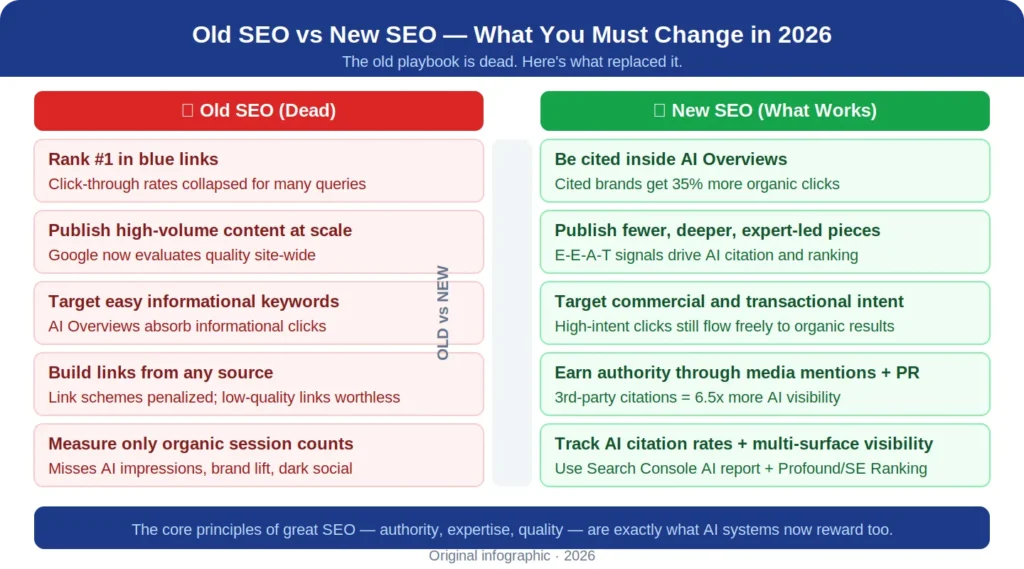
Is SEO dead? No. But here is what has genuinely changed — and what you must understand to stay relevant:
Zero-Click Searches Have Reshaped Informational SEO
Simple informational queries — “how tall is the Eiffel Tower,” “what time zone is Tokyo in,” “who wrote Hamlet” — are now almost entirely resolved by Google directly. These were never high-value traffic sources. Losing them is not a crisis for most businesses.
The searches that matter for most businesses — commercial, transactional, and complex informational queries — still drive substantial clicks. The zero-click searches are predominantly the ones Google can answer in a single sentence.
AI Overviews Have Separated Winners from Losers
AI Overviews don’t kill SEO traffic — they redistribute it. Brands cited inside the AIO earn dramatically more clicks. Brands not cited earn dramatically fewer. Ranking #1 in traditional organic results no longer guarantees AIO inclusion — citation overlap with the organic top-10 has weakened from 76% in mid-2025 to between 17% and 54% in early 2026, depending on the query type.
The new game is not “rank #1” — it is “be cited in the answer.”
E-E-A-T Has Become the Dominant Ranking Signal
Google’s December 2025 Core Update made site-wide quality evaluation standard — meaning Google now evaluates content collectively across your entire site, not just page by page. Mass-produced AI content that lacks human review, genuine expertise, and real-world context is being systematically deprioritized.
Experience, Expertise, Authoritativeness, and Trustworthiness — E-E-A-T — is now the lens through which both traditional rankings and AI citation decisions are made. Generic content, whoever produced it, fails these standards.
The Search Surface Has Expanded Dramatically
Is SEO dead on Google? Even if it were, that would only be part of the story. Search in 2026 now happens across Google, Bing, ChatGPT, Perplexity, YouTube, TikTok, Amazon, LinkedIn, Reddit, and voice assistants. Neil Patel’s 2026 framework calls this “Search Everywhere Optimization” — and it’s the most accurate description of what modern search marketing requires.
AI platforms account for approximately 6% of global search volume in 2026 — roughly triple what it was a year ago. That number is growing rapidly. Understanding how to appear in AI-generated answers is now a distinct discipline alongside traditional SEO.
Technical SEO Has Become More Critical, Not Less
Google’s December 2025 Core Update increased the ranking weight of technical performance. Pages with a Largest Contentful Paint (LCP) above 3 seconds experienced 23% more traffic loss than faster competitors. Poor Interaction to Next Paint (INP) scores above 300ms caused 31% ranking drops, especially on mobile. Structured data — schema markup — is now actively used by AI systems to understand and cite your content.
What’s Working in SEO Right Now
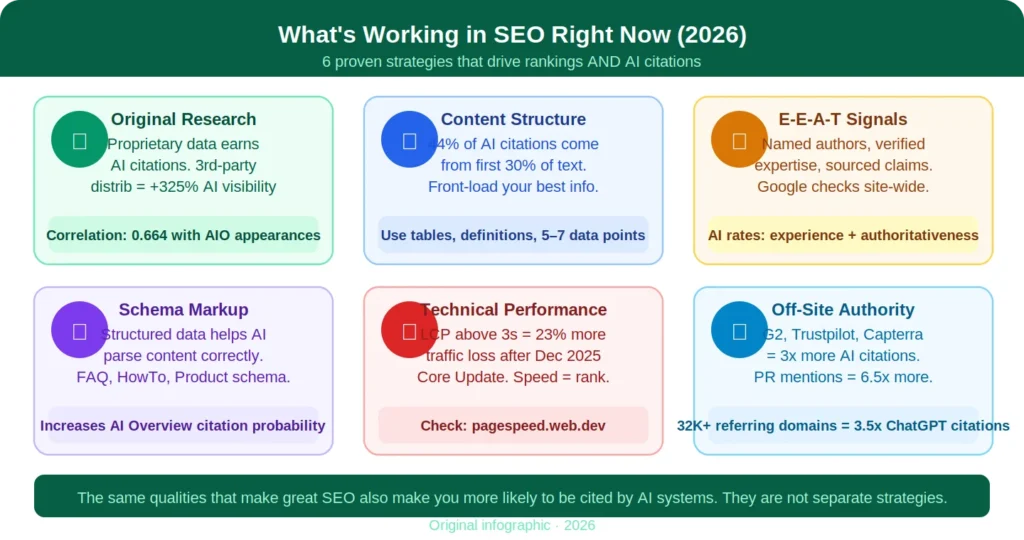
Is SEO dead for the strategies that are actually working? Far from it. Here’s what the evidence shows is driving results in 2026:
Original research and proprietary data. Content featuring unique data, original studies, and brand-attributed statistics earns significantly more AI citations. Research from Ahrefs 2026 shows that external brand mentions have a correlation of 0.664 with AI Overview appearances. Brands distributing content through third-party publications increase AI citations by up to 325% compared to only publishing on their own domains.
Comprehensive, well-structured content. AI systems reward content that leads with clear definitions, uses 5–7 data points per piece, employs comparison tables, and is written in plain language with short sentences. Forty-four percent of all LLM citations come from the first 30% of text — your introduction matters more than ever.
E-E-A-T signals. Content backed by demonstrable expertise, attributed to real authors with verifiable credentials, and supported by external references consistently outperforms generic content regardless of how well-optimized it is at the keyword level.
Schema markup and structured data. Pages with proper structured data are more likely to be cited in AI Overviews. FAQ schema, HowTo schema, LocalBusiness schema, and Product schema all give Google and AI systems explicit signals about your content’s structure and intent.
Technical performance. Fast, mobile-optimized, technically clean websites continue to significantly outperform slow or technically flawed competitors — and the performance gap has widened with recent algorithm updates.
Brand authority and third-party validation. Sites with over 32,000 referring domains are 3.5 times more likely to be cited by ChatGPT. Profiles on Trustpilot, G2, and Capterra increase citation likelihood by approximately 3 times. Getting mentioned in “best of” listicles and authoritative publications is now a direct driver of both traditional SEO rankings and AI visibility.
Local SEO for businesses with physical locations. 46% of all Google searches have local intent. Local mobile searches grow faster than overall search. For local businesses, SEO — particularly Google Business Profile optimization and local keyword targeting — remains one of the highest-converting digital channels available.
How to Adapt Your SEO Strategy for 2026
Is SEO dead if you keep doing what worked in 2020? For that version of SEO, yes. Here is what you need to do differently:
Step 1 — Audit Your Content for Genuine Quality
Review your existing content through the E-E-A-T lens. Ask: Does this demonstrate real experience? Is the author’s expertise verifiable? Are claims sourced and attributed? Would a knowledgeable person in this field endorse this content? Content that fails these tests needs to be improved or consolidated.
Step 2 — Shift Focus from Rankings to Citations
Track not only your organic rankings but also your visibility inside AI Overviews and AI chatbot answers. Google Search Console’s new Search Generative AI performance report lets you see which pages are being cited in AI Overviews. Use tools like Profound or SE Ranking to monitor your AI citation rate.
Step 3 — Optimize Content Structure for AI Extraction
AI systems extract answers from content that is structured clearly. Lead every article with a direct, quotable definition of the main topic. Use comparison tables, numbered lists, and defined sections with clear headings. Include 5–7 sourced data points per piece. Front-load your most important information — 44% of AI citations come from the first third of an article.
Step 4 — Build E-E-A-T Signals Off Your Site
Six and a half times more AI citations come from third-party sources than from a brand’s own domain, per Airops 2025 data. Invest in digital PR, guest contributions to authoritative publications, and building your presence on review platforms like G2, Trustpilot, and Capterra. These off-site mentions are now a primary driver of both AI visibility and traditional authority.
Step 5 — Fix Your Technical Foundation
Run a full Core Web Vitals audit. If your LCP is above 2.5 seconds or your INP is above 200ms, fixing this is your highest-priority SEO task. Implement schema markup for your content type. Ensure your site is fully mobile-optimized. These are table-stakes requirements in 2026 — not competitive advantages.
Step 6 — Expand to Multi-Platform Search Visibility
Optimize your presence on YouTube (the most-cited domain across LLM answers overall as of January 2026), Reddit, LinkedIn (most-cited for professional and B2B queries), and relevant review platforms. Your content strategy in 2026 must account for search behavior happening across multiple surfaces, not just Google’s blue links.
Examples of SEO Working in 2026
Example 1 — The B2B SaaS Company A project management software company invested in original research — publishing an annual “State of Remote Work” report with proprietary survey data. The report was cited in Google AI Overviews for 47 different queries related to remote work productivity. Each AI Overview citation drove 35% more organic clicks to the cited page than non-cited competitors received, and the brand saw an 18% increase in branded search volume over six months — a direct result of AI exposure building brand recognition.
Example 2 — The Local Service Business A plumbing company in Dallas optimized its Google Business Profile, implemented LocalBusiness schema on its website, and published locally-targeted content answering common questions from Dallas homeowners. Despite zero-click searches rising, their inbound call volume from search increased 34% — because local transactional searches still deliver clicks at high rates, and their technical SEO improvements made them the consistently featured result in local map packs.
Example 3 — The E-Commerce Brand An outdoor gear retailer shifted from targeting informational keywords (where AI Overviews suppress clicks) to focusing exclusively on commercial and transactional keywords — product comparisons, “best of” roundups, and specific product queries with buying intent. Their organic traffic from informational content declined, but revenue from organic search increased 22% because the traffic they were losing was low-intent and the traffic they were gaining was high-intent and conversion-ready.
Case Studies
Case Study 1 — Publisher Caught in the AI Traffic Collapse
Background: A mid-size digital publication producing 50+ articles per week focused primarily on informational content answering common questions. The business model was built on display advertising revenue tied directly to page views.
What happened: Between January 2024 and January 2026, the site’s organic traffic dropped 61% as Google AI Overviews absorbed the informational queries that had been driving the majority of their traffic. Display ad revenue fell proportionally. The site had to cut staff by 30%.
What they did wrong: The site had built a business model entirely dependent on informational traffic for low-competition queries — exactly the traffic that AI Overviews absorb. They had no brand authority, no original research, no E-E-A-T signals, and no presence beyond Google’s blue links.
Key takeaway: Is SEO dead for this publisher? Effectively, yes — because they built their entire strategy on the weakest and most easily displaced part of SEO. The businesses that built authority, genuine expertise, and multi-surface visibility were far less affected.
Case Study 2 — The B2B Brand That Won With AI Citations
Background: A cybersecurity firm published a detailed, heavily sourced annual threat intelligence report. The report included original data from the firm’s own security monitoring systems, attributed to named experts on the team.
What happened: The report was cited in AI Overviews for 89 distinct queries related to cybersecurity threats, data breaches, and enterprise security. The firm’s website received a 41% increase in organic traffic in the months following the report’s publication — despite informational queries broadly declining. Inbound enterprise sales inquiries increased 28% quarter-over-quarter.
Why it worked: The content had everything AI systems reward — original proprietary data, named expert attribution, clear structure, comprehensive sourcing, and distribution through third-party security publications that increased its citation surface. Is SEO dead for businesses that produce genuinely authoritative content? Not even slightly.
Key takeaway: The businesses that win with SEO in 2026 are those treating content as genuine expertise, not keyword-stuffed volume.
Best Tools for Modern SEO in 2026
| Tool | Best For | Price |
|---|---|---|
| Google Search Console | Tracking rankings, AI Overview citations, Core Web Vitals | Free |
| Ahrefs | Keyword research, backlink analysis, content gap analysis | From $129/month |
| Semrush | All-in-one SEO platform including competitor AI visibility | From $139.95/month |
| Surfer SEO | NLP-based content optimization for AI extraction | From $89/month |
| SE Ranking | AI Overview monitoring and citation tracking | From $65/month |
| Profound | AI citation tracking across ChatGPT, Perplexity, Gemini | Custom pricing |
| PageSpeed Insights | Core Web Vitals and technical performance auditing | Free |
| Screaming Frog | Technical SEO site crawling and schema validation | Free / £259/year |
| BrightEdge | Enterprise AI visibility and SERP feature tracking | Enterprise pricing |
| Google Trends | Understanding keyword trajectory and emerging topics | Free |
For expert ongoing coverage of how AI is reshaping search, Search Engine Land and Search Engine Journal publish the most reliable, data-backed analysis of SEO developments in 2026.
Common Mistakes That Make SEO Feel Dead
Is SEO dead, or are these mistakes making it feel that way? Most businesses experiencing an SEO crisis are making one or more of these errors:
Mistake 1: Publishing AI-generated content without human review Google’s December 2025 Core Update explicitly targets mass-produced AI content that lacks human expertise and real-world context. Publishing unreviewed AI output is not a content strategy — it’s a fast path to ranking penalties. AI is a drafting tool, not a publishing pipeline.
Mistake 2: Measuring only direct organic clicks If you’re measuring SEO success only by direct session counts from Google Analytics, you’re missing AI Overview impressions, brand lift from AI citations, dark social referrals, and the influence of branded search volume growth. Traditional attribution dramatically undervalues SEO’s contribution in 2026.
Mistake 3: Targeting only informational keywords Informational queries are the ones most aggressively absorbed by AI Overviews and zero-click results. Businesses that built their SEO strategy entirely on informational content are the ones experiencing the most pain. Shift emphasis to commercial, transactional, and complex research-stage queries.
Mistake 4: Ignoring technical SEO Page speed, Core Web Vitals, schema markup, mobile optimization, and clean crawlability are now minimum standards, not competitive advantages. Sites neglecting technical SEO are being systematically penalized by recent algorithm updates regardless of their content quality.
Mistake 5: Building links instead of building authority Low-quality link building — link farms, paid link schemes, private blog networks — is not just ineffective in 2026; it is actively penalized. Authentic authority signals — original research, expert attribution, third-party media mentions, review platform presence — are what both Google and AI systems measure.
Mistake 6: Not tracking AI visibility Most businesses still only measure traditional organic rankings. They have no visibility into whether their content is being cited in AI Overviews, ChatGPT responses, or Perplexity answers — surfaces that now account for an increasing share of how users discover content. You cannot optimize what you cannot measure.
Mistake 7: Abandoning SEO based on short-term traffic dips Algorithm updates cause short-term volatility. Businesses that exit SEO during volatility cede long-term authority to competitors who stay the course. The businesses that built organic search authority over 2–3 years are the ones dominating AI citations today — because AI systems reward exactly the authority signals that time-tested SEO produces.
FAQs
Q: Is SEO dead in 2026? No. Google still processes over 5 trillion searches per year. Organic traffic declined by only 2.5% between February 2024 and November 2025 — not the catastrophic collapse many predicted. SEO is evolving, not dying. The businesses asking “is SEO dead?” and exiting the channel are handing market share to competitors who understand what SEO has become.
Q: Is SEO dead because of AI Overviews? AI Overviews have materially reduced click-through rates for informational queries where Google can answer the question directly. But brands cited inside AI Overviews earn 35% more organic clicks than non-cited brands on the same SERP. AI Overviews don’t kill SEO — they reward the best SEO and punish the mediocre.
Q: Is SEO dead for small businesses? No — particularly for local businesses. Local SEO remains one of the highest-converting digital marketing channels available. 46% of all Google searches have local intent. Local transactional queries still drive high click-through rates because Google cannot fully answer “find a plumber near me” without sending the user somewhere.
Q: Is SEO dead for bloggers? Blogging built on thin informational content targeting low-competition keywords is effectively dead. Blogging built on genuine expertise, original research, and content that demonstrates real experience is very much alive — and becoming more valuable as generic content proliferates. The bar has risen sharply. The opportunity for those who clear it has risen equally.
Q: What has replaced traditional SEO? Nothing has replaced it — it has expanded. Modern search optimization in 2026 encompasses traditional SEO (Google rankings), GEO (Generative Engine Optimization — being cited in AI answers), AEO (Answer Engine Optimization — appearing in featured snippets and voice search), and multi-platform search visibility across YouTube, Reddit, LinkedIn, and review platforms. Traditional SEO remains the foundation of all of it.
Q: How long does SEO take to work in 2026? SEO still requires a 4–6 month minimum investment before meaningful results appear. AI citation authority tends to build even more slowly — the brands appearing most consistently in AI answers today have typically been building domain authority and external mentions for 2–3 years or more. This is not a channel for impatient, short-term thinking.
Q: Is SEO dead for e-commerce businesses? No. Commercial and transactional queries — where users are comparing products or ready to buy — retain high click-through rates even in the presence of AI features. E-commerce SEO focused on product schema, category page optimization, and commercial intent keywords remains highly effective. The traffic that has declined is low-intent informational traffic that rarely converted anyway.
Conclusion
Is SEO dead? The data gives a clear answer: no. But the version of SEO that too many businesses practiced — publishing thin content at scale, targeting the easiest keywords, and treating organic clicks as a self-sufficient growth channel — is finished. That version deserved to die.
What’s alive, and growing in importance, is SEO as a discipline of genuine authority-building: creating content that demonstrates real expertise, earning citations from credible third parties, maintaining technical excellence, and appearing not just in Google’s blue links but across every surface where your audience searches for answers.
Is SEO dead for businesses that treat it as a shortcut? Yes. Is SEO dead for those who treat it as a long-term investment in visibility and authority? Absolutely not — and those businesses are quietly widening their lead over the competitors who panicked and walked away.
Google processes more searches today than at any point in its history. The opportunity in organic search has never been larger. The bar to capture it has simply — and justifiably — risen.
Related Reading: What Are SEO Keywords? The Proven Guide | On-Page SEO Checklist for WordPress 2026
Actionable Takeaways
✅ Stop asking “is SEO dead” and start asking “what does SEO require now” — the channel is alive; your strategy may need to evolve.
✅ Audit your content for E-E-A-T — identify your 10 most important pages and ask whether they demonstrate verifiable expertise and real-world experience. Upgrade those that don’t.
✅ Check your AI Overview visibility today — open Google Search Console and review the new Search Generative AI performance report. Find out which of your pages are being cited and which aren’t.
✅ Optimize your content structure for AI extraction — start every article with a direct, quotable definition. Include 5–7 sourced data points. Use comparison tables. Front-load your most important information.
✅ Run a Core Web Vitals audit at pagespeed.web.dev — if your LCP is above 2.5 seconds, fixing it is your highest-priority SEO task in 2026.
✅ Build your off-site authority — get listed on G2, Trustpilot, and Capterra where relevant. Pitch original data to industry publications. Each third-party mention increases your AI citation probability.
✅ Shift keyword focus toward commercial and transactional intent — identify the keywords in your strategy that represent informational queries now answered by AI Overviews. Replace them with commercial investigation and transactional terms where clicks still flow freely.
✅ Commit for the long term — SEO authority compounds. The businesses winning AI citations today built their domain authority over years. Start now, stay consistent, and the returns compound in your favor.