Introduction
What are SEO keywords? If you’ve ever wondered why some web pages rank at the top of Google while others sit invisible on page 10 — the answer almost always comes back to keywords. SEO keywords are the foundation of every successful search engine optimization strategy. They’re the bridge between what your audience is searching for and the content you publish.
Here’s a number that should get your attention: 94.74% of all keywords receive 10 or fewer monthly searches. Meanwhile, long-tail keywords — specific phrases of three or more words — account for up to 92% of all search traffic and convert at an average rate of 36%. That means the businesses that understand what are SEO keywords, and how to choose the right ones, are quietly capturing the majority of valuable organic traffic while their competitors chase the same handful of high-volume head terms.
In this guide, you’ll learn:
- What are SEO keywords — a clear, practical definition
- Why SEO keywords are critical to your website’s success
- The main types of SEO keywords and when to use each
- How to find and choose the right keywords for your content
- How to use SEO keywords correctly once you have them
- Real examples, case studies, and tools to get you started
Related Reading: What’s SEO? The Complete Beginner’s Guide | How to Write SEO-Optimized Blog Posts
Table of Contents
- What Are SEO Keywords?
- Why Are SEO Keywords Important?
- Benefits of Using the Right SEO Keywords
- Types of SEO Keywords You Need to Know
- How to Find SEO Keywords — Step by Step
- How to Use SEO Keywords in Your Content
- Examples of SEO Keywords in Action
- Case Studies
- Best Tools for SEO Keyword Research
- Common Mistakes When Using SEO Keywords
- FAQs
- Conclusion
- Actionable Takeaways
What Are SEO Keywords?
What are SEO keywords? At the most fundamental level, SEO keywords (also called keyphrases or search terms) are the words and phrases that people type into search engines like Google when they’re looking for information, products, or services. They are also the terms you strategically include in your content to help search engines understand what your page is about — and to match it to the right searches.
Think of SEO keywords as a two-sided bridge:
- One side: The actual words your target audience types into Google
- Other side: The words and phrases you use in your content, titles, meta descriptions, and headings
When those two sides align, Google recognizes your page as a relevant result for that search — and ranks it accordingly.
For example, if you sell running shoes and a potential customer searches “best running shoes for flat feet,” that four-word phrase is an SEO keyword. If your product page or blog post uses that phrase naturally in the right places, Google is far more likely to show your page to that searcher.
According to Backlinko’s SEO keyword guide, what are SEO keywords in practice comes down to this: they are terms added to online content in order to improve search engine rankings for those terms — and they are most effective when chosen based on a combination of search volume, competition, and commercial intent.
What are SEO keywords not? They are not the same as paid advertising keywords (though there is overlap). They are not just single words. And they are not about stuffing your content with repeated phrases — Google’s algorithms have evolved far beyond simple keyword matching and now assess context, intent, and content quality.
Why Are SEO Keywords Important?
Understanding what are SEO keywords is the first step. The second is understanding why they matter so much — and the data here is striking.
They determine whether Google shows your page at all Keywords are the primary signal that tells Google what your content is about. Without strategically placed, relevant keywords, even a brilliantly written page can go completely unnoticed. Google cannot rank what it cannot understand.
85% of searches are three words or longer Ahrefs data shows that only 2.8% of searches consist of a single word, while more than 85% of all searches are three or more words. This is why targeting specific keyword phrases — not just broad single-word terms — is critical. The searches where buying decisions are made almost always involve longer, more specific phrases.
15% of Google’s daily queries are completely new Google processes approximately 8.5 billion searches every day — and 15% of those searches have never been searched before. This means the keyword landscape is constantly evolving. New questions, new products, and new trends generate fresh keyword opportunities every single day for businesses that are paying attention.
Keyword choice directly determines your traffic quality Not all traffic is equal. Someone searching “shoes” could be looking for anything. Someone searching “women’s trail running shoes for wide feet under $100” is ready to buy. Understanding what are SEO keywords and choosing them based on intent dramatically affects how valuable the traffic you attract actually is.
The right keywords connect you to buyers at the right moment Search intent research consistently shows that users at the bottom of the buying funnel — those closest to making a purchase — use longer, more specific keyword phrases. What are SEO keywords if not a direct line to your ideal customer at the exact moment they need what you offer?
Also Read: On-Page SEO Checklist for WordPress | How to Do Keyword Research for Beginners
Benefits of Using the Right SEO Keywords
What are SEO keywords worth to your business? Here are the specific, proven benefits:
Higher search engine rankings. Pages that use well-researched, relevant keywords in the right places consistently outrank pages that don’t. Keywords in title tags, H1 headings, first paragraphs, and URLs all contribute to ranking signals Google uses to evaluate relevance.
More qualified organic traffic. Targeting the specific phrases your ideal customers actually search for means the people arriving at your site are already interested in what you offer — not random visitors with no buying intent.
Better conversion rates. Long-tail SEO keywords — specific phrases of three or more words — convert at an average rate of 36%, compared to just 0.17% for single-word terms. A three-word keyword converts at 1.02%, a five-word keyword at 1.58%, and a six-word keyword peaks at 1.94%. Specificity equals intent, and intent equals conversions.
Lower competition. The more specific a keyword phrase, the fewer competitors are targeting it. This makes it far more achievable for small businesses and new websites to rank on page 1 for long-tail terms than to compete for broad head keywords dominated by large, established brands.
Audience insight. The keywords your customers search for reveal exactly how they think about their problems, what language they use, and what solutions they’re seeking. This intelligence is valuable far beyond SEO — it informs your product descriptions, email subject lines, ad copy, and social media content.
Long-term compounding value. Unlike paid ads that stop the moment your budget runs out, a page that ranks for the right keywords generates free traffic month after month. The investment in keyword research and content creation compounds in value over time.
Competitive edge. If your competitors aren’t targeting specific long-tail keyword variations in your niche, those phrases represent ranking opportunities available to you right now. Identifying and capturing those gaps can deliver significant traffic gains with relatively low effort.
Types of SEO Keywords You Need to Know
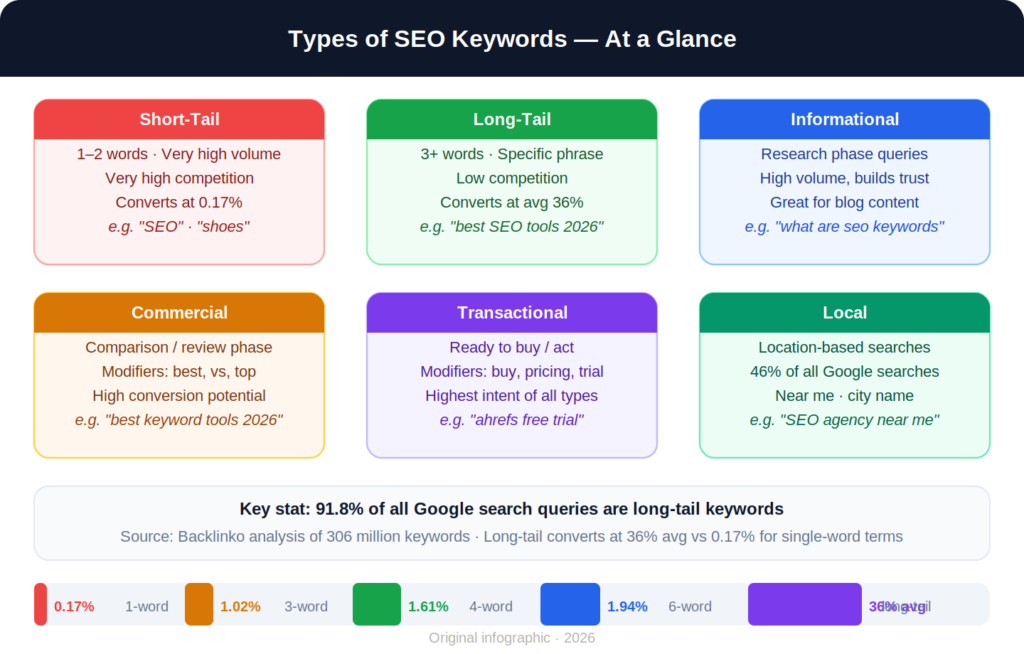
What are SEO keywords broken down by type? The keyword landscape is more nuanced than most beginners realize. Here’s a comprehensive breakdown of every keyword type you’ll encounter:
Short-Tail Keywords (Head Terms)
Short-tail keywords are broad, single-word or two-word phrases with very high search volume and extremely high competition.
Examples: “SEO,” “shoes,” “laptops,” “marketing”
Characteristics:
- High monthly search volume (often hundreds of thousands or millions)
- Very high competition — dominated by large, authoritative websites
- Low conversion rate (approximately 0.17% for one-word terms)
- Unclear search intent — the same word can mean many things
When to use them: Short-tail keywords are important for brand awareness and broad topic coverage, but almost impossible for new or small websites to rank for. Use them as the overarching theme for your content, not as your primary ranking target.
Long-Tail Keywords
Long-tail keywords are specific phrases of three or more words. They have lower individual search volumes but dramatically higher conversion rates and far lower competition.
Examples: “best running shoes for flat feet,” “how to do SEO for a small business,” “SEO keyword research tools for beginners”
Characteristics:
- Lower individual search volume, but collectively account for 70–92% of all search traffic
- 91.8% of all Google search queries are long-tail keywords (Backlinko analysis of 306 million keywords)
- Average conversion rate of 36% — more than 2.5x higher than short-tail terms
- Clear search intent — the user knows exactly what they’re looking for
- Much lower competition — making first-page rankings achievable for smaller sites
When to use them: Long-tail keywords should form the backbone of your content strategy, particularly for new websites, niche businesses, and any content designed to convert rather than just attract traffic.
Informational Keywords
Informational keywords are used by people who want to learn something. They’re not yet ready to buy — they’re in the research phase.
Examples: “what are SEO keywords,” “how does Google ranking work,” “what is a backlink”
Characteristics:
- Often phrased as questions: “what,” “how,” “why,” “when,” “can I”
- High volume, moderate competition
- Lower conversion intent — users want answers, not products
- Excellent for building brand authority and trust
- Well-suited to blog posts, guides, and tutorials
When to use them: Create informational content to attract users early in the buyer’s journey. These pages build topical authority and often earn backlinks naturally — which benefits your entire site’s rankings over time.
Navigational Keywords
Navigational keywords are searches where the user is trying to reach a specific website or page.
Examples: “Google Search Console login,” “Ahrefs keyword tool,” “Search Engine Journal SEO guide”
Characteristics:
- High conversion rate (the user knows where they’re going)
- Dominated by the brand or website being searched for
- Very difficult for third parties to rank for intentionally
When to use them: Navigational keywords are most relevant for branded SEO — ensuring your own brand terms rank correctly. They’re not typically targets for content marketing campaigns.
Commercial Investigation Keywords
Commercial keywords are used by shoppers who are comparing options before making a purchase decision. They have serious buying intent but haven’t committed yet.
Examples: “best SEO tools 2026,” “Ahrefs vs Semrush comparison,” “top keyword research software reviews”
Characteristics:
- Strong buying signal — users are actively evaluating options
- Common modifiers: “best,” “top,” “review,” “vs,” “comparison,” “alternatives”
- High conversion potential
- Well-suited to comparison articles, roundups, and product reviews
When to use them: Target commercial keywords with comparison posts, buyer’s guides, and “best of” content. These pages sit between informational and transactional in the funnel and often deliver the highest ROI of any content type.
Transactional Keywords
Transactional keywords signal that a user is ready to take action — make a purchase, sign up, or request a quote.
Examples: “buy SEO software,” “Ahrefs free trial,” “hire SEO consultant,” “keyword research tool pricing”
Characteristics:
- Highest conversion intent of any keyword type
- Common modifiers: “buy,” “order,” “get,” “download,” “free trial,” “pricing,” “near me”
- Lower search volume than informational terms, but extremely high value per visitor
- Perfect for product pages, service pages, and landing pages
When to use them: Every product page, service page, and conversion-focused landing page on your site should target transactional keywords. These are the terms users search immediately before converting.
LSI Keywords (Semantic Keywords)
LSI (Latent Semantic Indexing) keywords are conceptually related terms and synonyms that help Google understand the full context of your content.
Examples: For a page targeting “SEO keywords,” LSI keywords might include: “search terms,” “keyphrases,” “keyword research,” “search queries,” “organic search,” “SERP rankings”
Characteristics:
- Not the same as your primary keyword — these are supporting terms
- Help prevent keyword stuffing while improving topical relevance
- Signal to Google that your content covers a topic comprehensively
When to use them: Weave LSI keywords naturally throughout your content. Tools like Google’s “Searches Related To” section at the bottom of search results, Google Autocomplete, and platforms like Surfer SEO can help you identify the right semantic terms to include.
Local Keywords
Local keywords target users searching for products or services in a specific geographic area.
Examples: “SEO agency in New York,” “digital marketing consultant near me,” “best running shoes store Chicago”
Characteristics:
- Include location modifiers: city names, neighborhoods, “near me,” “open now”
- 46% of all Google searches have local intent
- 82% of smartphone users use “near me” queries to find local businesses
- 76% of mobile users who search locally visit a business within 24 hours
- 18% of local mobile searches lead to a sale within one day
When to use them: Any business serving a specific geographic area should target local keywords in their Google Business Profile, location pages, and content. Local SEO delivers some of the highest conversion rates of any keyword category.
How to Find SEO Keywords — Step by Step
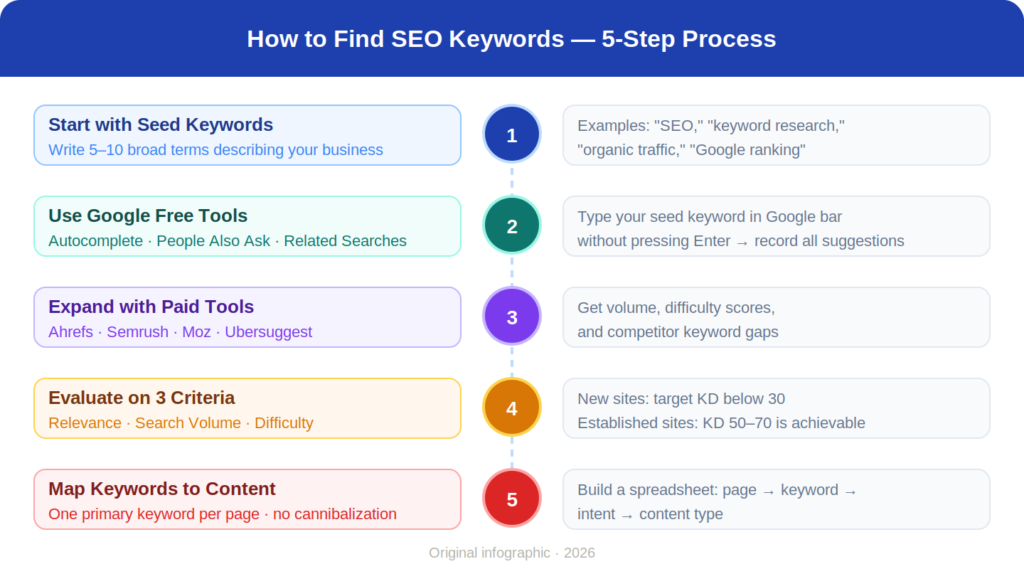
Now that you understand what are SEO keywords and their types, here’s the practical process for finding the right ones for your business.
Step 1 — Start with Seed Keywords
Seed keywords are the broad, obvious terms that describe your business, products, or content topics. They’re the starting point for your research — not final targets.
Write down 5–10 seed keywords based on:
- Your main products or services
- The problems your customers come to you to solve
- The language your customers use when describing their needs
For example, if you run an SEO blog, your seed keywords might be: “SEO,” “keyword research,” “Google ranking,” “organic traffic,” “search engine optimization.”
Step 2 — Use Google’s Free Tools
Before investing in paid tools, extract as much as possible from Google’s own free features:
Google Autocomplete: Start typing a seed keyword in Google’s search bar without pressing Enter. The dropdown suggestions are real searches that real people are making — excellent long-tail keyword ideas.
People Also Ask: The expandable question boxes in Google search results reveal exactly what related questions your audience is asking. Each one is a potential piece of content.
Related Searches: Scroll to the bottom of any Google results page for “Searches related to [your keyword]” — another gold mine of long-tail variations.
Google Search Console: If your site already has some traffic, Search Console shows you the exact queries people are using to find your site. These are your current keywords — and they reveal opportunities you may not be targeting intentionally.
Step 3 — Expand with Keyword Research Tools
Free tools only go so far. Professional keyword research tools reveal search volume, competition scores, keyword difficulty, and related term clusters that are impossible to find manually.
The most effective tools for keyword research are covered in the Best Tools section below.
Step 4 — Evaluate Keywords on Three Criteria
Not every keyword you find is worth targeting. Evaluate candidates against these three factors:
Relevance: Does this keyword directly relate to your content, products, or services? Irrelevant traffic — visitors who find your page but don’t find what they’re looking for — hurts your bounce rate and signals to Google that your page isn’t the right result.
Search volume: How many people search for this term per month? Higher volume means more potential traffic, but also more competition. Balance volume with achievability.
Keyword difficulty / Competition: How hard is it to rank for this keyword? Tools like Ahrefs and Semrush score this on a 0–100 scale. New or smaller websites should target keywords with difficulty scores below 30–40. Established sites can compete for higher-difficulty terms.
Step 5 — Map Keywords to Content
Every page on your site should target one primary keyword and a handful of supporting (LSI) keywords. Avoid targeting the same keyword across multiple pages — this creates “keyword cannibalization,” where your own pages compete against each other in Google’s rankings.
Build a keyword map: a spreadsheet that lists each page or planned piece of content alongside its primary keyword, supporting keywords, target audience, and search intent. This becomes your content roadmap.
How to Use SEO Keywords in Your Content
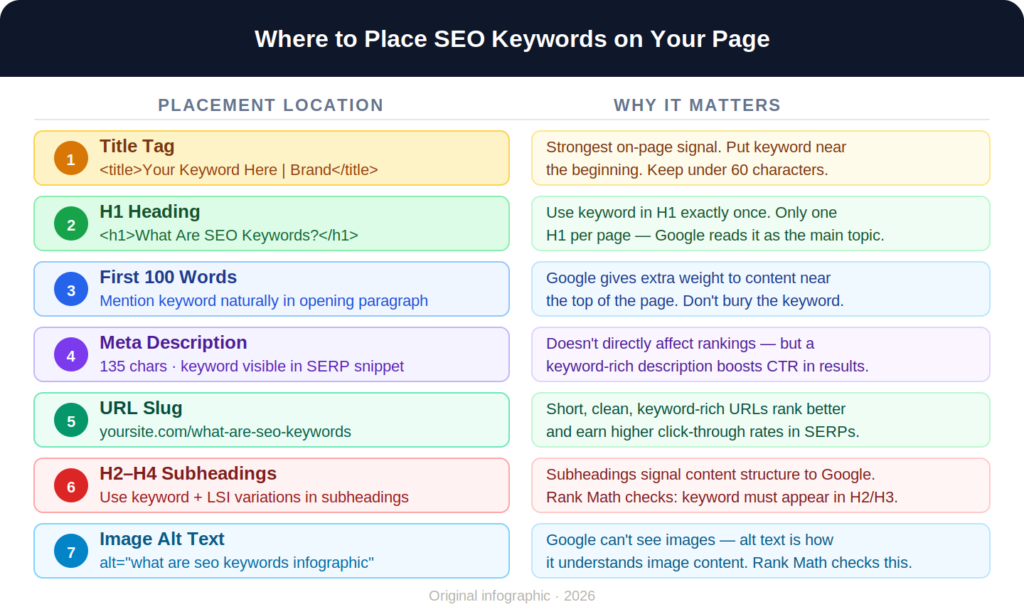
Finding the right keywords is half the battle. Knowing where and how to use them is the other half. Here’s the complete placement guide:
Title tag: Your primary keyword should appear in the page’s title tag — ideally near the beginning. The title tag is one of Google’s strongest on-page ranking signals. Keep titles under 60 characters to avoid truncation in search results.
H1 heading: Your page’s main heading (H1) should include your primary keyword. Only use one H1 per page.
First 100 words of content: Google pays extra attention to content near the top of your page. Use your primary keyword naturally within the first paragraph.
Meta description: While meta descriptions don’t directly affect rankings, they appear in search results and influence click-through rates. Include your primary keyword here.
URL slug: Short, keyword-rich URLs perform better. Use your primary keyword in the URL: /what-are-seo-keywords rather than /blog/post-2458.
Subheadings (H2–H4): Use your primary keyword and LSI variations in your subheadings where they fit naturally.
Image alt text: Search engines cannot see images. Describe each image using relevant keywords in the alt attribute.
Throughout the body: Use your primary keyword naturally several times in the body text. A keyword density of 0.5–2% is a reasonable guideline — but never sacrifice readability. Use LSI keywords and synonyms throughout to cover the topic comprehensively without over-repeating any single phrase.
Internal links: Link to and from related pages using anchor text that includes your target keywords. This passes authority and signals content relationships to Google.
One critical rule: Never keyword stuff. Google’s algorithms — particularly the BERT and MUM updates — are highly sophisticated at detecting unnatural keyword repetition and will actively penalize it. Write for humans first; optimize for search engines second.
Examples of SEO Keywords in Action
Example 1 — E-Commerce Product Page
A fitness brand selling resistance bands wants more organic sales. Instead of targeting “resistance bands” (high competition, low intent), they create product pages optimized for:
- “resistance bands for glute training women” (long-tail, transactional)
- “resistance bands with handles for home gym” (long-tail, transactional)
- “fabric resistance bands vs rubber bands” (commercial investigation)
Each page targets a specific, high-intent phrase. The result: lower competition, higher relevance to the buyer’s search, and significantly better conversion rates.
Example 2 — Local Service Business
A plumber in Austin, Texas targets:
- “emergency plumber Austin TX” (local + transactional)
- “water heater replacement cost Austin” (local + commercial)
- “how to fix a leaking pipe under sink” (informational — builds trust)
The informational page attracts people early in the problem-solving journey and builds brand trust. The local transactional pages capture users who are ready to book. Together they cover the entire search funnel.
Example 3 — B2B SaaS Company
A project management tool targets:
- “project management software for remote teams” (commercial investigation)
- “best Asana alternative for small business” (commercial + competitor term)
- “how to manage remote team workflow” (informational)
- “project management tool free trial” (transactional)
Each keyword type maps to a different stage of the buyer’s journey and a different type of content — guides, comparison pages, and product landing pages respectively.
Case Studies
Case Study 1 — Long-Tail Keywords Over Head Terms
Scenario: A startup SaaS company launched a project tracking tool into a market dominated by Asana and Monday.com. Competing for “project management software” was impossible — those positions were locked up by brands with domain authority scores of 80+.
Strategy: Instead of targeting head terms, the team conducted deep keyword research and identified 200+ long-tail phrases their competitors had overlooked: “project tracking for freelancers,” “simple task manager for small agencies,” “kanban board for 5-person team.”
Result: Within nine months, the site ranked on page 1 for 147 of those long-tail phrases. Each term drove modest traffic individually — but collectively they generated over 40,000 monthly organic visitors, with a 28% trial sign-up rate. The traffic from their long-tail strategy converted at 6x the rate of their paid search campaigns targeting broad terms.
Key takeaway: What are SEO keywords worth when you choose specificity over volume? Enormously more than broad terms — when conversion is the goal.
Case Study 2 — Keyword Intent Mismatch Costs Rankings
Scenario: A digital marketing agency created a detailed blog post targeting “email marketing.” The post was 3,000 words, well-written, and thoroughly optimized. It never ranked past page 5.
Diagnosis: The keyword “email marketing” is dominated by navigational and commercial results — users searching for it want tools, platforms, and software (Mailchimp, HubSpot, Klaviyo), not a general blog post. The content type completely mismatched the search intent behind the keyword.
Fix: The agency rewrote the content to target “how to improve email marketing open rates for small businesses” — an informational long-tail phrase that perfectly matched a blog post format. The revised page ranked on page 1 within three months.
Key takeaway: Knowing what are SEO keywords is not enough — you must match your content type to the search intent behind the keyword, or Google will never rank you regardless of content quality.
Best Tools for SEO Keyword Research
| Tool | Best For | Price |
|---|---|---|
| Google Keyword Planner | Free search volume data; great starting point | Free |
| Google Search Console | Finding keywords your site already ranks for | Free |
| Ahrefs Keywords Explorer | Deep keyword research, difficulty scores, competitor gaps | From $129/month |
| Semrush | All-in-one keyword research + competitive analysis | From $139.95/month |
| Ubersuggest | Budget-friendly keyword suggestions | Free / From $12/month |
| AnswerThePublic | Question-based keyword discovery | Free / From $9/month |
| Google Trends | Keyword trend analysis over time | Free |
| Surfer SEO | NLP-based content optimization with semantic keywords | From $89/month |
| Moz Keyword Explorer | Keyword difficulty + priority scoring | From $99/month |
| Keyword.io | Pulling autocomplete suggestions from multiple platforms | Free / Paid |
For an expert-level deep dive into keyword research methodology, Search Engine Land’s keyword research guide is one of the most thorough publicly available resources on the topic. Search Engine Journal also publishes regularly updated guides covering keyword strategy for 2026.
Common Mistakes When Using SEO Keywords
Even experienced content creators misuse what are SEO keywords in ways that actively hurt their rankings. Here are the most damaging errors to avoid:
Mistake 1: Targeting keywords that are too broad and too competitive New websites cannot rank for “SEO,” “digital marketing,” or “email marketing.” These terms are dominated by sites with domain authority scores built over a decade. Start with long-tail, low-competition keywords and build authority gradually.
Mistake 2: Keyword stuffing Repeating your target keyword unnaturally throughout your content — “If you want to learn what are SEO keywords, you need to understand what are SEO keywords because what are SEO keywords is important” — is a direct path to Google penalties. Use your keyword naturally and rely on semantic variations to cover the topic.
Mistake 3: Ignoring search intent Matching the wrong content format to a keyword’s intent is one of the most common and costly SEO mistakes. If Google’s first page for your target keyword is full of product pages, creating a blog post won’t rank — regardless of quality. Always check the SERP before creating content.
Mistake 4: Using one keyword across multiple pages When multiple pages on your site target the same keyword, they compete against each other in Google’s index — a problem called keyword cannibalization. Assign each keyword to exactly one page and use internal links to reinforce the hierarchy.
Mistake 5: Neglecting long-tail opportunities Chasing only high-volume head terms while ignoring the long-tail is like fishing in the ocean with a net full of holes. Long-tail keywords account for 91.8% of all search queries and convert at 36% on average. They represent the majority of the opportunity — and most businesses leave them completely uncaptured.
Mistake 6: Not updating keyword strategy regularly Search behavior changes. New competitors emerge. Google algorithm updates shift ranking patterns. A keyword strategy set in 2023 may be significantly outdated in 2026. Audit your keyword performance quarterly and refresh content targeting keywords that have dropped in rankings.
Mistake 7: Forgetting to check keyword trends A keyword might show impressive monthly search volume — but if it’s trending downward on Google Trends, that volume is declining. Always check trend direction before investing heavily in content targeting any keyword.
FAQs
Q: What are SEO keywords in simple terms? SEO keywords are the words and phrases that people type into Google when searching for information, products, or services. By including these terms strategically in your website content, you help Google understand what your page is about — so it can show your page to the right searchers at the right time.
Q: How many SEO keywords should I use per page? Each page should target one primary keyword and 3–5 supporting (LSI/semantic) keywords. There’s no magic number for how many times to use a keyword in the body text, but a natural density of 0.5–2% is a broadly accepted guideline. The most important placement points are: title tag, H1, first paragraph, URL, meta description, and at least one subheading.
Q: What’s the difference between short-tail and long-tail keywords? Short-tail keywords are broad phrases of one or two words with high search volume and high competition (e.g., “SEO”). Long-tail keywords are specific phrases of three or more words with lower individual volume but much higher conversion rates and lower competition (e.g., “how to do keyword research for a new blog”). Long-tail keywords account for 91.8% of all search queries and convert at an average rate of 36%.
Q: Are free keyword research tools good enough? Free tools — especially Google Keyword Planner, Google Search Console, Google Autocomplete, and Google Trends — are genuinely useful, particularly for beginners. They’re excellent starting points. However, paid tools like Ahrefs and Semrush provide deeper data: keyword difficulty scores, competitor keyword gaps, SERP analysis, and large-scale keyword discovery that simply isn’t available for free.
Q: How do I know which keywords my competitors are ranking for? Tools like Ahrefs and Semrush allow you to enter any competitor’s domain and see exactly which keywords are driving their organic traffic. This “competitor keyword gap” analysis is one of the most efficient ways to find high-value keyword opportunities you’re currently missing.
Q: What is keyword difficulty and what score should I target? Keyword difficulty (KD) is a metric scored from 0–100 by tools like Ahrefs and Semrush that estimates how hard it would be to rank on page 1 for a given keyword. New or low-authority websites should target keywords with a KD score below 30. Established sites with strong backlink profiles can compete for keywords with KD scores of 50–70. Keywords above 80 are generally only achievable for very high-authority domains.
Q: Do SEO keywords still matter with AI-generated search results? Yes — more than ever. Google’s AI Overviews now appear in over 54% of search queries, but the pages selected as sources for those overviews are precisely those that rank well for the relevant keywords. Understanding what are SEO keywords and optimizing for them correctly is what gets your content cited by AI search systems — making keyword strategy even more critical in the AI era than before.
Conclusion
What are SEO keywords? They are the single most important element of any search engine optimization strategy. Every piece of content you publish, every page you optimize, and every technical fix you implement ultimately exists to help the right keywords connect the right users to your website.
The businesses winning in organic search in 2026 are not those chasing the same handful of high-volume head terms as everyone else. They are the ones who deeply understand what are SEO keywords across the full spectrum — short and long-tail, informational and transactional, local and semantic — and build content strategies that systematically capture every stage of the buyer’s journey.
The numbers tell the story: 91.8% of all search queries are long-tail keywords. Long-tail terms convert at 36% on average. And 15% of daily Google searches have never been searched before — meaning new opportunities emerge every single day for businesses that are researching and acting on keyword data.
Start with your seed keywords. Expand with free tools. Evaluate candidates for relevance, volume, and difficulty. Map them to your content. And revisit your keyword strategy every quarter. That consistent discipline is what separates the sites that grow steadily in organic traffic from those that never move.
Related Reading: How to Build a Keyword Strategy from Scratch | Technical SEO Audit Checklist for Beginners
Actionable Takeaways
✅ Define your seed keywords today — write down 5–10 broad terms that describe your business, products, or content topics. These are the foundation of your entire keyword research process.
✅ Run Google Autocomplete on each seed keyword — type each one into Google without pressing Enter and record every suggestion. These are real searches people are making right now.
✅ Check the People Also Ask boxes — for every keyword you research, Google’s PAA section reveals the exact questions your audience is asking. Each one is a content opportunity.
✅ Prioritize long-tail keywords — if your website is less than two years old or has low domain authority, avoid head terms entirely. Focus exclusively on long-tail phrases with keyword difficulty scores below 30.
✅ Match your content type to search intent — before writing any piece of content, Google your target keyword and study what types of pages rank on page 1. Match your format to what Google already rewards for that keyword.
✅ Build a keyword map — create a simple spreadsheet with each page on your site, its target keyword, and its search intent. Ensure no two pages target the same primary keyword.
✅ Set up Google Search Console — if you haven’t already, it’s free and shows you which keywords your site already ranks for. Look for keywords ranking in positions 5–20 — small optimization improvements to those pages can move them to position 1–3 with significant traffic impact.
✅ Review and refresh quarterly — keyword performance changes. Schedule a quarterly review of your top pages’ rankings and update content targeting any keywords that have slipped.