Introduction
What’s SEO? If you’ve ever typed something into Google and wondered why certain websites show up first — and others don’t show up at all — you’ve already witnessed SEO at work.
SEO, or search engine optimization, is the practice of improving your website so that it appears higher in Google and other search engines when people search for topics related to your business. Done right, it drives a steady stream of free, targeted traffic to your site — month after month — without paying for a single click.
And the numbers back this up. Organic search accounts for approximately 53% of all trackable website traffic. The global SEO industry hit nearly $107 billion in 2025 and continues to grow. Seven out of ten marketers say SEO is one of the most effective channels for driving sales.
But what’s SEO, really — and how does it actually work in 2026? This guide covers everything from the ground up: what SEO is, why it matters, how search engines work, the three main types of SEO, and exactly how to get started.
Related Reading: How to Do Keyword Research for Beginners | On-Page SEO Checklist for WordPress
What’s SEO — A Simple Definition
What’s SEO? At its core, SEO (search engine optimization) is the process of improving your website so that search engines like Google rank it higher in their organic (unpaid) results for relevant search queries.
When someone types “best running shoes for beginners” into Google, they get a list of results. The websites that appear at the top didn’t pay Google to be there — they earned those positions through SEO. Every page on that first page of results has been optimized to signal to Google that it’s the most relevant, trustworthy, and useful answer to that search.
Here’s a simple way to think about it:
SEO = helping search engines understand your content + helping users find and trust your website.
Google’s own definition aligns with this. According to Google’s Search Starter Guide, SEO is “about helping search engines understand your content, and helping users find your site and make a decision about whether they should visit your site through a search engine.”
What’s SEO not? It’s not paid advertising (that’s PPC). It’s not social media marketing. And it’s not a one-time task — SEO is an ongoing process that compounds in value over time.
Why Is SEO Important?
Understanding what’s SEO is only the first step. The bigger question is: why does it matter for your business?
1. Organic search is the largest source of website traffic Organic search drives approximately 53% of all website traffic, making it the single biggest traffic channel — larger than social media, paid advertising, email, and direct visits combined. Social media, by comparison, drives only about 5% of site traffic.
2. The top result gets most of the clicks The first organic result on Google has an average click-through rate (CTR) of 39.8%. Position 2 gets 18.7%. Position 3 gets 10.2%. Only 0.67% of searchers ever click anything on page 2. If your website isn’t on page 1, it’s effectively invisible to the vast majority of searchers.
3. SEO delivers exceptional ROI A well-executed SEO campaign can deliver a 748% return on investment over a three-year period. SEO also generates an 8x ROI — double the 4x return of PPC (pay-per-click advertising). In B2B specifically, organic search generates 44.6% of all revenue, making it the single largest revenue channel.
4. 68% of online experiences begin with a search engine Whether people are researching a product, looking for a local service, or trying to solve a problem, they start with a search. If your website doesn’t appear in those searches, you’re missing the majority of potential customers at the most critical moment: when they’re actively looking for what you offer.
5. The market is only getting more competitive The global SEO services market reached $74.9 billion in 2025 and is projected to grow to $127.3 billion by 2030. Nearly 97% of all websites get zero organic traffic from Google. Understanding what’s SEO and investing in it now is the difference between being found and being invisible.
Also Read: What Is the Difference Between SEO and SEM? | How Long Does SEO Take to Show Results?
Benefits of SEO for Your Website
What’s SEO worth to your business? Here are the specific benefits of investing in search engine optimization:
Free, compounding traffic. Unlike paid ads that stop the moment you stop paying, SEO traffic continues flowing long after the initial investment. A well-optimized article published today can drive traffic for years.
Higher-quality leads. SEO leads have a 14.6% close rate compared to just 1.7% for outbound methods like cold email or print ads. People who find you through organic search are actively looking for what you offer — they’re already interested.
Brand credibility and trust. Users inherently trust organic results more than paid ads. Appearing at the top of Google for your target keywords signals authority and expertise in your field.
Cost efficiency. Companies that implement SEO strategies save up to 400% on ad spend compared to relying solely on paid channels, without sacrificing traffic or leads.
Competitive advantage. Moving up a single position in Google search results can increase your CTR by 32.3%. That incremental improvement compounds across hundreds or thousands of keywords.
Local visibility. For businesses with a physical location, local SEO drives foot traffic. Local mobile searches grow 50% faster than overall searches, and smartphones accounted for 77% of retail site visits in Q3 2025.
Long-term business asset. A strong SEO presence is a business asset that accumulates value over time. The websites that rank on Google’s first page today have, on average, been there for more than three years — that kind of momentum doesn’t happen with paid ads.
How Search Engines Work
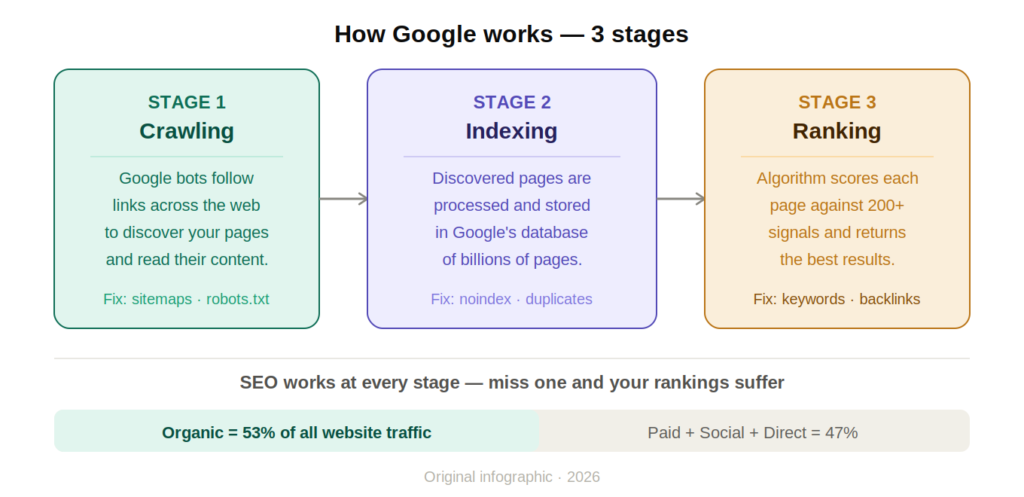
To understand what’s SEO, you need to understand how search engines actually work. Google’s process has three main stages:
Stage 1 — Crawling
Google uses automated bots called “crawlers” (also known as spiders or Googlebot) to discover content on the web. These bots follow links from page to page, reading the content of each page they visit.
If your website has pages that aren’t linked to from anywhere — or if you’ve accidentally blocked crawlers in your robots.txt file — Google may never discover them.
Stage 2 — Indexing
Once a page is crawled, Google processes and stores it in its index — a giant database of billions of web pages. When you search for something on Google, you’re not actually searching the web in real time; you’re searching Google’s index.
For a page to appear in search results, it must be indexed first. Common indexing issues — like duplicate content, thin content, or pages marked “noindex” — can prevent your content from ever appearing.
Stage 3 — Ranking
When someone performs a search, Google’s algorithm analyzes its index and returns the pages it considers most relevant, authoritative, and trustworthy for that query. Google uses over 200 ranking signals to make this determination, including:
- The relevance of the page’s content to the search query
- The quality and quantity of backlinks pointing to the page
- Page speed and Core Web Vitals
- Mobile-friendliness
- User experience signals
- E-E-A-T (Experience, Expertise, Authoritativeness, Trustworthiness)
The 3 Main Types of SEO
Now that you understand what’s SEO at a basic level, let’s go deeper into the three main branches of search engine optimization.
Type 1 — On-Page SEO
On-page SEO refers to all the optimizations you make directly on your website pages to help search engines understand your content and rank it higher.
Key on-page SEO elements include:
Keyword optimization — Using your target keyword in the right places: the page title, H1 heading, first paragraph, subheadings, and naturally throughout the content.
Title tags and meta descriptions — The title tag is one of the strongest on-page signals. Pages with URLs that contain a keyword earn a 45% higher CTR than those without. Meta descriptions don’t directly affect rankings but significantly impact click-through rates.
Header structure (H1–H3) — A clear heading hierarchy helps both users and search engines understand your content’s structure. Nearly 100% of first-page Google results use their keyword in the title or H1.
Internal linking — Linking between related pages on your own site passes authority and helps users navigate. It also helps Google discover and understand your content architecture.
Content quality and depth — Google rewards content that genuinely answers a user’s question comprehensively. Thin content (fewer than ~500 words) rarely ranks. Pillar content (1,500+ words covering a topic thoroughly) tends to perform significantly better.
Image optimization — Every image on your site should have a descriptive filename and alt text. Search engines can’t see images the way humans can — they rely on alt text to understand what an image contains.
Type 2 — Off-Page SEO
Off-page SEO refers to everything that happens outside your website that influences your rankings — primarily backlinks.
Backlinks are links from other websites pointing to yours. They act as votes of confidence: when a high-authority website links to your page, it signals to Google that your content is trustworthy and valuable.
Pages that rank number 1 on Google have, on average, 3.8 times more backlinks than those in positions 2 through 10. Nearly 80% of SEO professionals say link building is a key part of their strategy.
Effective link-building strategies include:
- Creating original research or data that others naturally want to cite
- Guest posting on authoritative websites in your industry
- Digital PR — earning press mentions and coverage from news publications
- Building free tools or resources that attract links organically
- Broken link building — finding dead links on other sites and offering your content as a replacement
Type 3 — Technical SEO
Technical SEO refers to optimizing the infrastructure of your website so that search engine crawlers can efficiently access, crawl, index, and render your pages.
Key technical SEO areas include:
Site speed and Core Web Vitals — Google has increased the ranking weight of Core Web Vitals by 35% compared to 2024. Sites with good Core Web Vitals see 32% higher organic traffic growth compared to non-compliant sites. Page speed is critical: if your load time goes from 1 second to 3 seconds, the probability of a user bouncing increases by 32%.
Mobile-friendliness — Google uses mobile-first indexing, meaning it primarily uses the mobile version of your site for ranking. With 62.73% of global website traffic now coming from smartphones, mobile optimization is non-negotiable.
Structured data (Schema markup) — Schema markup helps search engines understand your content’s context and can unlock rich results in SERPs (star ratings, FAQs, how-to steps, etc.). Implementing schema markup can increase organic traffic by up to 30%.
Crawlability — Making sure your site’s pages are discoverable and accessible to Google’s crawlers. This includes a clean XML sitemap, a well-configured robots.txt file, and no accidental noindex tags.
HTTPS — Secure sites (HTTPS) are a confirmed Google ranking signal. If your site still runs on HTTP, switching is a straightforward win.
How to Start Doing SEO — Step by Step
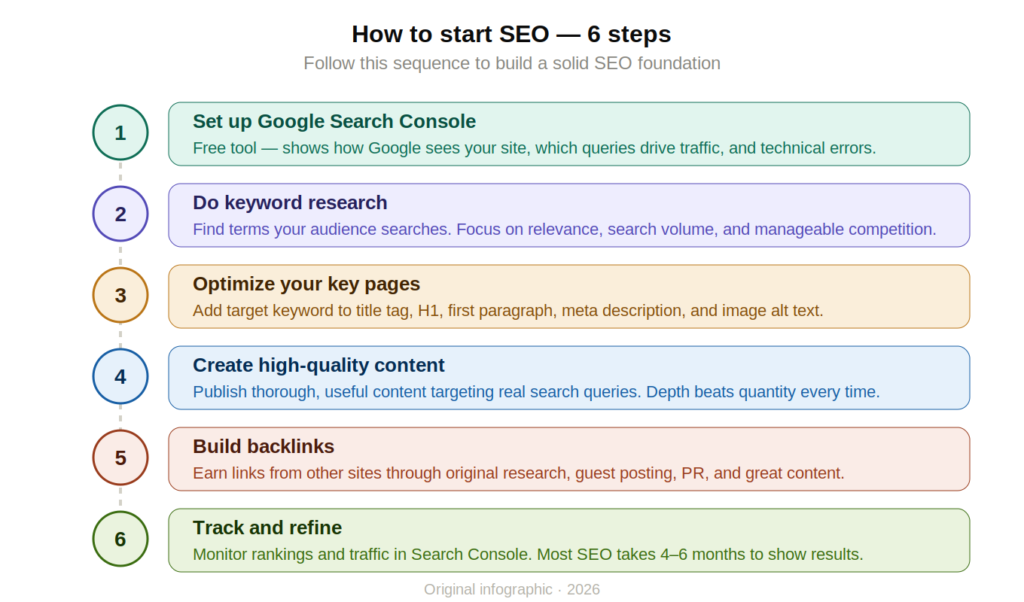
Now that you understand what’s SEO and its three pillars, here’s exactly how to get started.
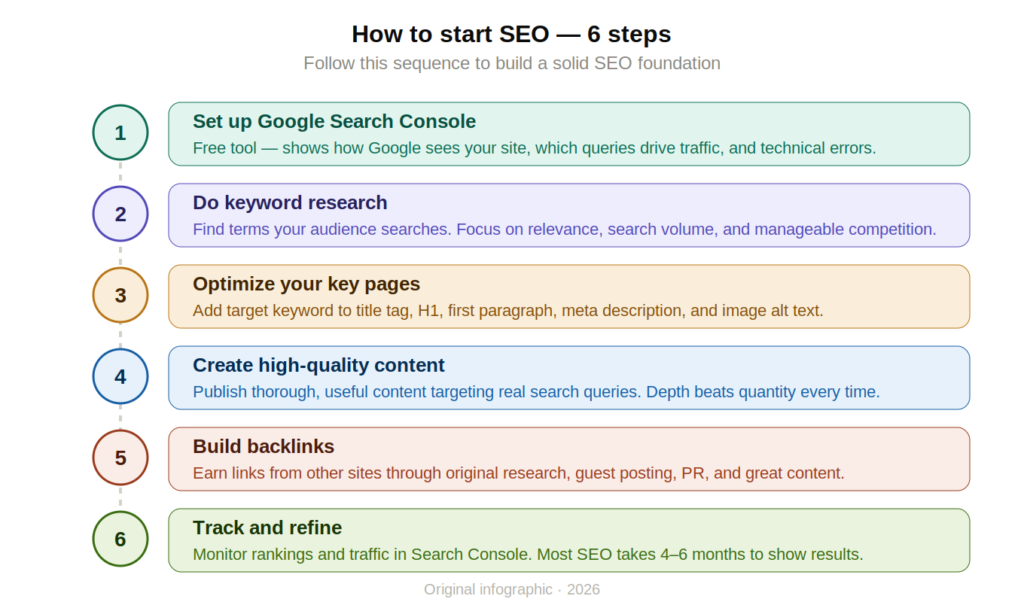
Step 1 — Set Up Google Search Console
Google Search Console is a free tool that shows you how Google sees your website. It tells you which queries bring visitors to your site, which pages are indexed, and flags any technical issues. Set this up before doing anything else.
Visit Google Search Console and verify your domain.
Step 2 — Do Keyword Research
Keyword research is the process of finding the specific terms your target audience types into search engines. Focus on:
- Relevance: Does the keyword relate to your business or content?
- Search volume: How many people search for it each month?
- Competition: How hard is it to rank for?
Start with tools like Google Keyword Planner (free), Ahrefs, or Semrush. Target a mix of high-volume head terms and lower-competition long-tail keywords.
Step 3 — Optimize Your Most Important Pages
For each key page on your site, make sure:
- The target keyword appears in the title tag, H1, first paragraph, and naturally throughout the content
- The meta description is compelling and includes the keyword
- All images have descriptive alt text
- The page loads quickly on mobile
- There are internal links to and from related pages
Step 4 — Create High-Quality Content
Content is the engine of SEO. Publish content that answers real questions your audience is searching for. Use your keyword research to guide topics. Aim for thoroughness — cover the topic more completely than competing pages.
Step 5 — Build Backlinks
Start by creating content worth linking to — original research, comprehensive guides, free tools. Then reach out to other websites in your industry, contribute guest posts, and build relationships with journalists and bloggers who cover your niche. For a deep dive, see Search Engine Land’s complete guide to SEO.
Step 6 — Track and Refine
SEO takes time. Most strategies take 4–6 months to show meaningful results, though technical fixes can produce improvements in weeks. Use Google Search Console and Google Analytics to track your rankings, traffic, and click-through rates. Refine your strategy based on what’s working.
Examples of SEO in Action
Example 1 — The Local Business A plumbing company in Austin, Texas wants more customers. They optimize their Google Business Profile, add location-specific keywords to their website (“emergency plumber Austin”), and get listed in local directories. Within three months, they appear in the local map pack for “plumber near me” searches — the three results that show at the top of Google with a map. Their inbound call volume doubles without spending a dollar on ads.
Example 2 — The E-Commerce Store A fitness equipment brand writes a detailed blog post titled “Best Home Gym Equipment for Small Spaces (2026 Guide).” They include buyer intent keywords, product comparisons, and internal links to their product pages. The article ranks on page 1 for multiple related search terms, driving consistent organic traffic that converts at a higher rate than paid ad visitors.
Example 3 — The SaaS Company A project management software company creates a free template library — downloadable templates for agendas, project plans, and status reports. The library attracts thousands of backlinks from blogs and resources sites who recommend the templates. Those backlinks boost the domain authority of the entire site, lifting rankings for their core commercial keywords.
Case Studies
Case Study 1 — Backlinko (Brian Dean)
Backlinko grew to over 562,000 monthly visitors using a content strategy called the “Skyscraper Technique.” The approach: find content that already ranks well, create a significantly better version, then reach out to sites linking to the original. The result was high-authority backlinks from industry publications and a number-one ranking for competitive SEO keywords — achieved without a single paid ad.
Key takeaway: Depth and differentiation beat quantity. One outstanding piece of content outperforms ten average ones.
Case Study 2 — A Small Business Technical SEO Fix
A regional e-commerce store noticed a sudden traffic drop after a website redesign. An audit revealed that hundreds of product pages had been accidentally marked “noindex” during the migration. Removing the noindex tags and resubmitting the sitemap to Google Search Console restored rankings within six weeks.
Key takeaway: Technical SEO errors can silently destroy traffic. Regular audits are essential, especially after any major site change.
Best SEO Tools in 2026
| Tool | Best For | Pricing |
|---|---|---|
| Google Search Console | Monitoring indexing, performance, and errors | Free |
| Google Analytics 4 | Tracking traffic, conversions, and user behavior | Free |
| Ahrefs | Keyword research, backlink analysis, competitor research | From $129/month |
| Semrush | All-in-one SEO platform — keywords, audits, tracking | From $139.95/month |
| Screaming Frog | Technical SEO site crawling and auditing | Free up to 500 URLs; £259/year for unlimited |
| Rank Math | WordPress on-page SEO plugin with real-time scoring | Free / Pro from $6.99/month |
| Yoast SEO | WordPress SEO plugin, beginner-friendly | Free / Premium from $99/year |
| Surfer SEO | Content optimization and NLP analysis | From $89/month |
| PageSpeed Insights | Measuring Core Web Vitals and page speed | Free |
| Moz Pro | Keyword tracking, domain authority metrics | From $99/month |
For more expert coverage on tools, resources, and industry news, Search Engine Journal is the most comprehensive publicly available resource in the field.
Common SEO Mistakes to Avoid
Understanding what’s SEO also means knowing what not to do. Here are the most frequent errors — especially damaging for beginners:
Mistake 1: Targeting keywords that are too competitive New websites can’t immediately rank for head terms like “SEO” or “digital marketing.” Start with long-tail keywords (3–5 word phrases with lower competition) to build early wins and domain authority before targeting more competitive terms.
Mistake 2: Ignoring mobile optimization With over 62% of global traffic coming from mobile devices and Google using mobile-first indexing, a site that isn’t optimized for mobile will struggle to rank — regardless of how good the desktop version is.
Mistake 3: Creating thin content Pages with little depth — under 300 words, no structure, no unique value — rarely rank. Google’s algorithm rewards comprehensive, well-structured content that genuinely answers the user’s question.
Mistake 4: Neglecting technical SEO Even excellent content won’t rank if crawlers can’t access it. Broken pages, slow load times, duplicate content, and missing sitemaps are all technical issues that silently suppress rankings.
Mistake 5: Building low-quality backlinks Buying links from link farms or using automated link schemes is a direct violation of Google’s guidelines and can result in a manual penalty. Focus exclusively on earning links naturally or through legitimate outreach.
Mistake 6: Expecting instant results SEO is not a channel that delivers overnight traffic. Most strategies take 4–6 months to show meaningful results. Companies that abandon their SEO investment after 60 days never see the compounding returns that make the channel so powerful.
Mistake 7: Not tracking results If you’re not monitoring rankings, traffic, and conversions in Google Search Console and Google Analytics, you’re flying blind. Regular reporting reveals what’s working, what isn’t, and where to focus next.
FAQs
Q: What’s SEO in simple terms? SEO (search engine optimization) is the process of improving your website so it appears higher in Google and other search engines when people search for topics related to your business. Higher rankings = more free traffic = more potential customers.
Q: How long does SEO take to work? Most SEO strategies take 4–6 months to show meaningful results. Technical fixes (fixing broken links, removing noindex tags) can show results within weeks. Content strategies and link building take longer to compound. SEO is a long-term investment, not a quick fix.
Q: Is SEO free? The traffic itself is free — you don’t pay Google per click like you do with paid ads. However, the work involved in SEO (creating content, building links, technical optimization) requires either your time or money spent on professionals and tools. The return on that investment is, for most businesses, significantly higher than paid advertising over the long run.
Q: What’s the difference between SEO and SEM? SEO focuses on acquiring traffic from organic (unpaid) search results through website optimization. SEM (search engine marketing) combines both SEO and paid search advertising (PPC — like Google Ads) to generate traffic from search engines. SEO results take time to build; SEM can drive traffic immediately but stops when you stop paying.
Q: What’s SEO versus content marketing? They’re closely related but distinct. Content marketing is the practice of creating valuable content to attract and engage an audience. SEO is the practice of optimizing that content (and your website’s technical foundation) so search engines can find and rank it. The most effective digital strategies combine both: content marketing creates the asset, SEO ensures it gets discovered.
Q: Does SEO still matter with AI search? Yes, arguably more than ever. AI Overviews from Google now appear in over 54% of search queries. Websites that are cited as sources in AI Overviews can experience higher click-through rates than traditional featured snippets. The principles of good SEO — authoritative content, clear structure, strong E-E-A-T signals — are precisely what AI search systems reward.
Q: Can I do SEO myself? Yes, especially for a small business or personal site. The fundamentals of SEO — keyword research, on-page optimization, creating quality content, and setting up Google Search Console — are learnable skills. For larger, more competitive websites, working with an experienced SEO professional or agency accelerates results significantly.
Conclusion
What’s SEO? It’s the most powerful long-term digital marketing channel available to businesses of any size. It’s the reason some websites get thousands of free, targeted visitors every month while others sit invisible on page 10 — even with better products.
The core principles haven’t changed: help search engines understand your content, help users find and trust your website, and earn authority through the quality and depth of what you publish. What has changed is the sophistication required, the competition for rankings, and the expanding role of AI in how search results are generated and consumed.
Google processes an estimated 8.5 to 16 billion searches every day. Organic search still captures approximately 90% of all clicks from Google results. And the #1 ranked result gets nearly 40% of all clicks for any given query.
The businesses investing in SEO now are building an asset that will compound for years. The ones ignoring it are ceding ground to competitors who aren’t.
Now that you know what’s SEO and how it works, the next step is to take action.
Related Reading: How to Write SEO-Optimized Blog Posts | Technical SEO Audit Checklist for Beginners
Actionable Takeaways
✅ Set up Google Search Console today — it’s free, takes 10 minutes, and immediately shows you how Google sees your site. This is the single most important first step for any website.
✅ Run a keyword research session — use Google Keyword Planner or Ahrefs to find 10–20 keywords your target audience actually searches for. Build your content plan around those terms.
✅ Audit your existing pages — check your most important pages for keyword placement in the title tag, H1, first paragraph, and meta description. Fix any gaps.
✅ Check your page speed — visit PageSpeed Insights and run your homepage. If your Core Web Vitals scores are failing, fixing them is one of the highest-ROI technical improvements you can make.
✅ Publish one comprehensive piece of content — pick your most important keyword and write the most thorough, useful answer to that search query that exists on the internet. Depth beats quantity every time.
✅ Don’t expect overnight results — commit to at least 6 months of consistent effort. Track your rankings and traffic in Google Search Console weekly. Adjust based on what the data tells you.
✅ Build one backlink this week — reach out to one website or blogger in your niche with a genuine offer: a guest post, a collaboration, or a resource they’d find valuable. One quality backlink outweighs a hundred low-quality ones.